BraveShe
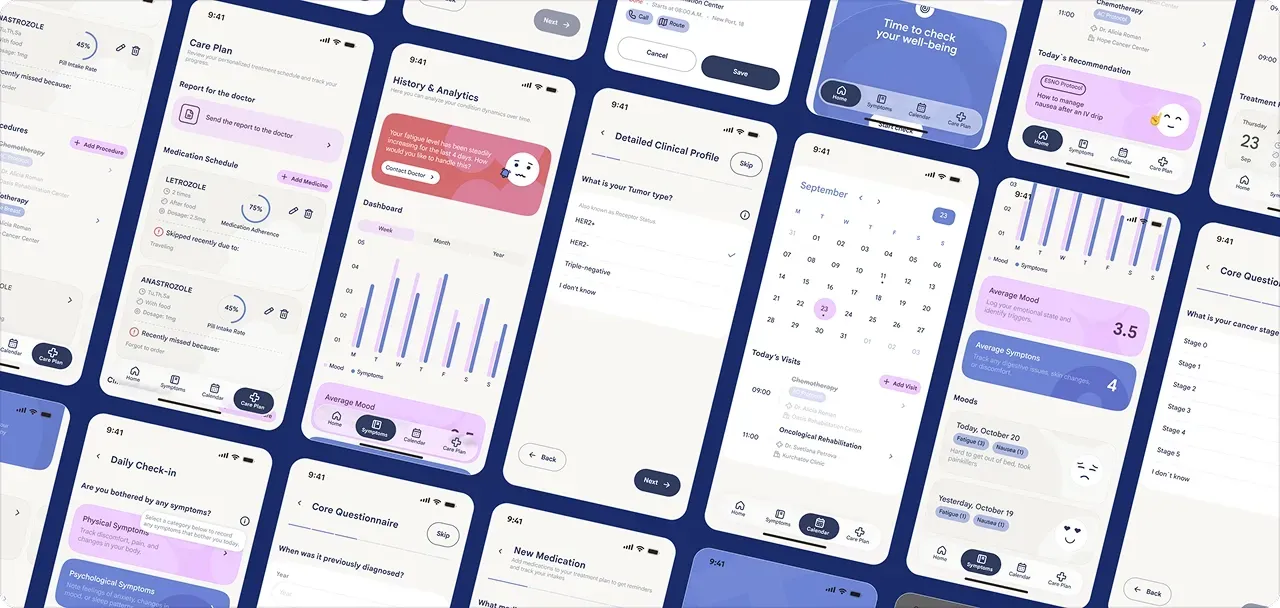
Full-cycle digital health companion for women with breast cancer — app, wearable, AI symptom tracking.

Industries
Country

United Kingdom

Ukraine
Services
What we did
AWS
·Cloud infrastructure
·Oncology support
·Hardware
·Digital Health
·IoT / Wearable
·Real-time Monitoring
·Privacy-first Architecture
Stack
React Native
·Expo
·Nest.js
·Node.js
·React
·PostgreSQL
·Redis
·WebSockets
·AI/ML
·AWS
·IoT
braveshe.com
Client
BraveShe is a digital health startup building support for women diagnosed with breast cancer across the full journey — from diagnosis to remission. Its product combines a mobile app and a wearable sensor with personalized treatment guidance, help finding oncology clinics where treatment is reimbursed, health monitoring, AI-driven symptom and mood tracking, and mental-health support. It's designed not only for patients, but for the ecosystem around them — doctors, clinics, pharmaceutical partners, and health systems. The goal behind it is simple and human: to help women feel less alone by giving them control, support, and coordinated care in one place.
Key Highlights
1 integrated system spanning a mobile app, a wearable sensor, an AI layer, and a secure backend.
5 stakeholder types served in one platform — patients, doctors, clinics, pharma, and health systems.
Real-time sensor-data streaming between the app and backend.
Full lifecycle delivered by a single team — design through deployment.
~$50K MVP — a full multi-component product (app, wearable, AI, backend) delivered within an MVP budget.
Research-led design — built on direct input from patient groups and doctors, not assumptions.
Challenge
The journey from a breast-cancer diagnosis to remission is fragmented and isolating: treatment information, clinic options, symptom monitoring, and emotional support are scattered across disconnected systems, and women often navigate the hardest moment of their lives without a single place that holds it all together. Breast cancer is also one of the most widely diagnosed cancers in the world, so the audience BraveShe set out to support is large and underserved.
BraveShe wanted to be that single connected place — which set a demanding technical brief:
- Unify a fragmented journey. Treatment guidance, reimbursed-clinic discovery, monitoring, and mental-health support had to live in one coherent product, not a set of disconnected features.
- Bring hardware, AI, and real-time data together. A wearable sensor, AI-based symptom and mood tracking, and continuous health monitoring only work if they feed one reliable, connected system.
- Serve five very different audiences. Patients, doctors, clinics, pharma partners, and health systems each need their own access, data, and workflows within the same platform.
Reliability and trust weren't features here — they were the foundation. When women at a vulnerable moment depend on a tool for monitoring, guidance, and support, downtime or a data error doesn't cost a sale; it erodes trust that is far harder to rebuild. And because the platform handles sensitive personal health information, privacy and security had to be designed in from the first line of code, not added later.
Solution
We took the product through its full lifecycle — UX/UI design, system architecture, mobile and backend development, third-party integrations, QA, deployment preparation, and ongoing technical support — making each core decision to serve reliability, sensitivity, and reach:
- React Native + Expo for the app, not separate native builds. One codebase delivers a consistent experience on iOS and Android, so BraveShe can reach women on the phones they already carry, faster and with less duplicated effort.
- A wearable sensor connected in real time, not periodic manual check-ins. We built the pipeline to stream sensor data continuously, so monitoring doesn't depend on a woman remembering to log it — support that works even when she has the least energy to seek it.
- An AI layer built to surface patterns, not to diagnose. The AI-driven symptom and mood tracking is designed to help women and their care teams notice trends over time and flag what may need attention — a supportive signal, not a clinical verdict.
- A multi-stakeholder architecture with role-based access. Patients, doctors, clinics, pharma, and health systems each see only what's relevant to their role, on a Nest.js/Node backend with PostgreSQL and Redis — one platform, five tailored experiences.
- Reimbursement-aware clinic guidance. Rather than a generic directory, the platform helps women find oncology clinics where treatment is reimbursed — removing a practical barrier at the point it matters.
Throughout, we treated privacy and security of health data as a first-order design constraint, not an afterthought.
Process
- Research with the people who'd actually use it — the real starting point. Before designing screens, we ran research sessions directly with patient groups and doctors, so the product was shaped by the lived reality of a breast-cancer journey and real clinical input — not by assumptions about either. That grounding informed everything downstream: which features mattered, how the journey should feel, and where the sensitivities were.
- Care-journey and stakeholder mapping. We mapped the path from diagnosis to remission and the distinct needs of all five audiences, so the architecture served a human journey rather than a feature list.
- Privacy-first architecture. Because the platform handles sensitive medical data, we designed the data model and access controls around privacy from the outset, so it shaped the build instead of being retrofitted.
- Hardware ↔ app integration — the hardest technical piece. Connecting a physical wearable sensor to the app and moving its data reliably in real time was the core engineering challenge; we built the data pipeline to keep readings flowing consistently during normal use.
- AI/ML for symptom and mood tracking. We implemented the tracking layer to identify trends in how a woman feels over time, structured to support — not replace — clinical judgment.
- Multi-stakeholder build, QA & deployment. We developed the patient app alongside role-based interfaces for doctors, clinics, pharma, and health systems, then tested, prepared, and deployed the product, and continue to support it as it moves toward launch.
Result
- A full product, built end to end. BraveShe now has its product developed and integrated by a single team — mobile app, wearable-sensor integration, AI-supported tracking, and a multi-stakeholder backend — from design through deployment.
- One connected experience where there was fragmentation. Treatment guidance, reimbursed-clinic discovery, monitoring, and emotional support now live in a single product rather than scattered across disconnected tools.
- A privacy-oriented, role-based foundation. Role-based access and a privacy-first architecture give the platform the data-protection structure a health product handling sensitive information requires.
- Positioned for launch and built to grow. With the waitlist live and a phased roadmap in place, the platform is ready to onboard patients and expand across its stakeholder ecosystem as it launches in stages.
Technologies: React Native · TypeScript · Nest.js · Node.js · PostgreSQL · Redis · Wearable sensor integration · Real-time data streaming · AI/ML for pattern detection · Role-based access control · Privacy-first architecture · Figma.


Explore more case studies
Explore all


Have a product that needs to impress from the first second?
Premium look and speed don't have to compete. ZentixSoft builds sites that convey the full value of your product - and open instantly on any device.
