Meet Up — High-retention dating app
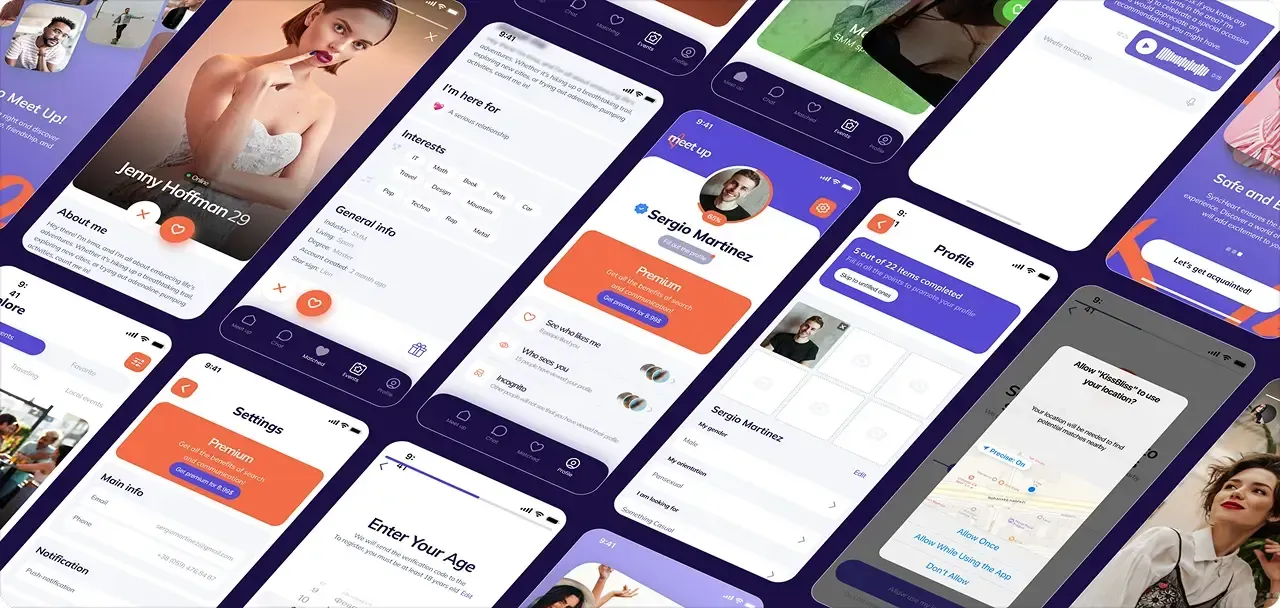
Meet Up – a dating app that uses gamification and real-time features to move users from endless chatting to real-life meetings.

Country

United States
Services
What we did
Dating App
·Real-Time Chat
·WebSockets
·Social Discovery
·Cross-Platform
·MVP
·Mobile App
·Gamification
Stack
Flutter
·Dart
·Node.js
·Express.js
·Socket.io
·Firebase
·Firestore
·Redis
Client
The client is an early-stage dating startup with a value proposition that runs against the category: bring people together online for a limited period, then do everything possible to move them offline. Rather than competing on yet another matching algorithm, the founders treat the offline meeting as the product's actual goal rather than a side effect — a deliberate bet that the market rewards meetings, not screen time.
Key Highlights
3 months from research to a launched MVP
2 platforms from 1 Flutter codebase — identical behavior on iOS and Android.
<100ms real-time message latency — over WebSockets.
99.5% uptime during the MVP phase — with a WebSocket layer built to scale horizontally.
Two-stage engagement: POC (~$10K) → MVP (~$35K) — concept validated first, then built out, so budget followed proof.
Challenge
There was no existing product to modernize — the challenge was a market one, and the founders had named it precisely: dating apps are optimized for time spent in the app, and time spent in the app is not the same thing as people meeting. Users swipe for weeks, exchange hundreds of messages, and then never meet. Chat fatigue sets in, the conversation dies, and both people move on to the next match. The very mechanics that make these apps engaging are the mechanics that keep the meeting from happening.
That single problem broke down into three causes the product had to address directly:
- Nothing limits the chat. Conversations run indefinitely, and nothing in the interface signals that it might be time to meet.
- Nothing rewards real-life action. Gamification in dating apps rewards in-app behavior — swipes, streaks, replies — never the meeting itself.
- The online-to-offline step feels unsafe and unclear. Even motivated users hesitate at exactly the moment the product needs them to act.
Four hard constraints shaped the build: real-time reliability (WebSocket connections had to survive reconnects and poor mobile networks); cross-platform consistency (the Flutter app had to behave identically on iOS and Android); safety and moderation (a baseline requirement for a product that encourages meeting strangers in person); and non-gameable rewards (if points could be earned through fake check-ins, the whole incentive system would be worthless within weeks).
Reliability mattered more than the MVP label suggests. According to the client's estimate, an hour of downtime during peak evening hours would cost hundreds of potential matches and chat sessions — with the real damage being churn among early adopters, the users an unlaunched product can least afford to lose.
Solution
We built a product where online interaction is engaging but time-bound, and the reward system pays out only for planning and completing real-world meetings. Four decisions carried the concept:
- Chat timer. After a configured volume of conversation, the app stops being a neutral chat window and starts suggesting a meeting, then progressively limits further chatting. The threshold is configurable rather than hard-coded, so the client can tune the pressure as they learn from real behavior.
- Meetup check-in. Both users confirm the meeting happened, and both receive rewards — badges and increased visibility. The reward attaches to the pair, not the individual, which makes the incentive mutual.
- Gamification dashboard. Leaderboards and achievements are built around completed offline dates, so progress in the app visibly tracks progress in real life.
- Instant meet-up notifications. WebSocket-based alerts fire the moment someone signals they want to meet, so intent doesn't cool off waiting for a push cycle.
Alongside these, we implemented a reporting and moderation flow — users can report inappropriate behavior, a non-negotiable safety baseline for a product that actively moves strangers into in-person meetings.
Process
We ran the engagement in clear, compressed stages — product decisions settled before design, design settled before build:
- Research (1 week). Validated the behavioral problem and the offline-meeting goal against the founders' user research.
- Scope & product logic (1 week). Defined the mechanics — chat timer, verification, rewards — as one connected loop rather than separate features.
- UI & interaction design (3–5 weeks). Designed the experience and the "encouragement-first" nudges that make the timer feel helpful, not punishing.
- Delivery (6 weeks). Built the cross-platform app, the real-time layer, and the verification and reward systems.
Engineering Deep Dive
Firebase alone didn't hold for chat. Our first approach ran real-time chat on Firebase's real-time primitives — the fastest path for a small team. In prototyping, message latency was higher than a chat product can afford, and the cost curve rose steeply with message volume, a poor fit for the projected user base. We split responsibilities instead: a custom Node.js WebSocket server for chat, and Firebase for what it does well — authentication, push notifications, and analytics.
The hardest problem wasn't technical. Implementing "forced offline" logic without making users feel punished took more iteration than the real-time layer did — a hard cutoff reads like a paywall. The answer was gradual nudges before any limit applies: the app first suggests the meeting in the user's own context ("You've sent 20 messages — why not meet at a coffee shop?"), and only then narrows the chat. Encouragement first, restriction last.
Meetup verification, built from scratch. Rewards for offline meetings only work if the meeting is hard to fake, and no off-the-shelf component does this. We built a verification system where users share a one-time code or their geolocation when they meet, and both sides must confirm within a limited time window before any reward is issued. It doesn't make fabrication theoretically impossible, but the two-sided, time-bound confirmation removes the easy path and makes casual gaming of the leaderboard impractical.
Stack and specific tooling. Flutter (Dart) with a Socket.io client on mobile; Node.js (Express), Socket.io, and the Firebase Admin SDK on the backend; Firestore for user profiles and matches, Redis for session state and chat history. The piece that matters most for growth: Socket.io with a Redis adapter, so the WebSocket layer scales horizontally across servers instead of being capped by a single process.
Result
The MVP shipped in three months, on two platforms, with the offline mechanic working end to end — chat timer, verification, and rewards operating as one loop rather than three separate features.
- Real-time chat performs as the concept requires. Message latency stays under 100ms, with reconnection handling for poor mobile networks — necessary, because a chat product that drops messages loses the conversation before it reaches a meeting.
- One codebase, two stores. Flutter delivers identical behavior on iOS and Android, with backend updates shipping weekly and mobile releases every two weeks.
- The MVP held its uptime. 99.5% during the MVP phase, with the WebSocket layer auto-scaling through the Redis adapter and authentication and push handled on Firebase's managed infrastructure.
- The incentive system launched intact. Two-sided, time-bound verification meant the reward economy went live without an obvious exploit — the failure mode that would have made every other metric meaningless.
Technologies: Flutter · Dart · Node.js · Express · Socket.io · Redis · Firestore · Firebase Admin SDK · WebSocket · Two-sided verification · Geolocation-based check-in.


Explore more case studies
Explore all


Have a product that needs to impress from the first second?
Premium look and speed don't have to compete. ZentixSoft builds sites that convey the full value of your product - and open instantly on any device.
