BestClevers LMS
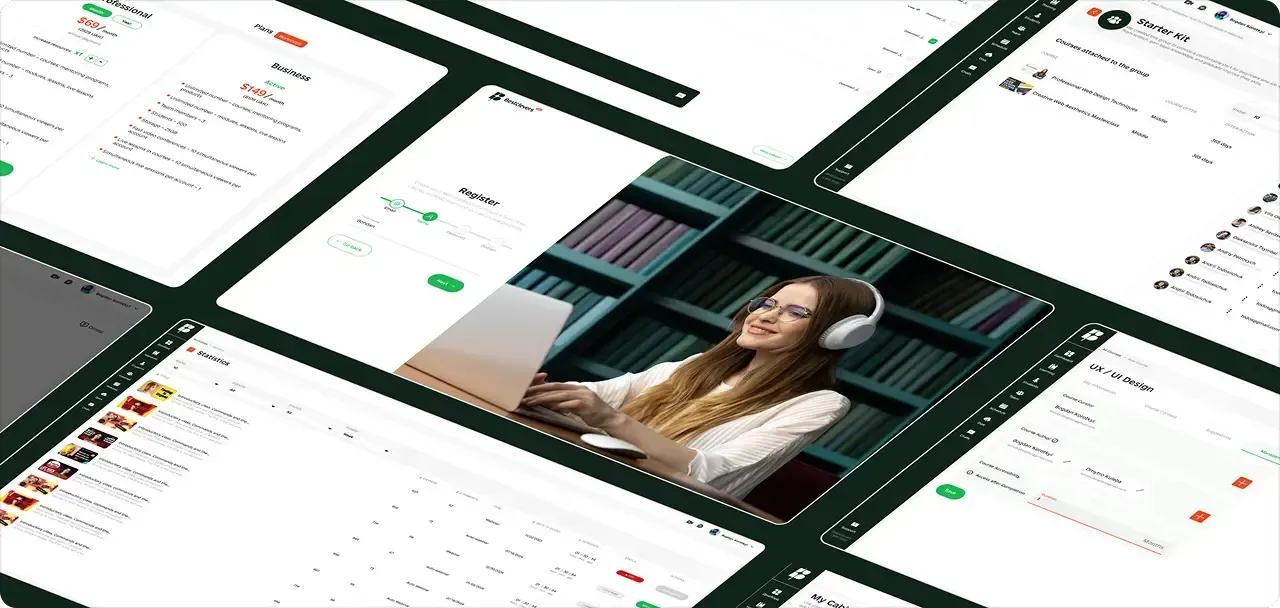
Full-cycle development of a multi-role LMS with webinars, scheduling, and mentor booking for educational institutions and companies.

Industries
Country

United Kingdom

Latvia
What we did
LMS
·E-learning
·Webinars
·Real-time / WebSockets
·Mentor Booking
·Video Streaming
·Role-based Platform
·B2B SaaS
Stack
Laravel
·Node.js
·React
·PostgreSQL
·Redis
·AWS
bestcleverslms.com
Client
The client is an EdTech company building a learning management platform for educational institutions and companies that manage training processes — from online schools to corporate training programs. The platform serves three very different user types at once: students, mentors, and administrators, each with their own interface, permissions, and daily workflows. It is designed for scale from day one: role-based access, group and individual scheduling, live and recorded webinars, and mentor session booking on a single platform.
Key Highlights
Scheduling conflicts reduced by 90% — through an automated calendar and booking system.
~5 hours per week saved per mentor — thanks to webinar recording and auto-webinar features.
Booking confirmation time cut from ~2 hours to under 1 second — from manual emails to real-time.
99.9% uptime reported for the real-time server — with automatic reconnection after network drops.
$250K full-cycle build — a 12-month enterprise LMS delivered by an 11-person team.
~7,500 engineering hours, delivered iteratively — built and refined in continuous iterations.
Challenge
Before the platform, the client ran their educational business on manual processes: spreadsheets for tracking, emails for coordination, and Zoom links sent by hand. What worked at a small scale became impossible to maintain as the business grew and B2B customers — schools and companies — expected a professional, automated product.
The core problem was the absence of a centralized system for education management, and it showed up in three ways:
- Booking conflicts. Shared calendars led to double-booked mentors and hours spent matching mentor availability with student requests.
- Missed content. There was no automated webinar recording, so students who missed a live session depended on someone manually sending them a recording.
- Missed sessions. Without real-time communication, students simply didn't know when a session had started.
Downtime carried a real price. For a school with 200+ students, the client estimated one hour of platform downtime at roughly $1,000 in refunds and churn — so reliability wasn't optional. The technical bar was equally clear: real-time connections had to survive network drops, three roles needed completely different interfaces and data access, and recorded webinars required efficient video storage and streaming.
We spent hours every week just matching mentor availability with student requests. And if someone missed a live webinar, we had to manually send recordings. It was a nightmare.
Solution
We built a modular architecture with a real-time core: Laravel as the main API for business logic, a dedicated Node.js WebSocket server for real-time events, and a React single-page application on the frontend, with Redis for queues and caching and AWS for scaling.
We arrived at this architecture deliberately, not by default:
- One platform, three roles, one booking flow. The client's business model depended on combining mentor booking with calendar sync, auto-webinars, and a dual student/mentor profile in a single product. That combination — not any single feature — defined the scope of the build.
- Not pure Laravel with polling. We prototyped the real-time layer before committing to it. Polling — constantly asking the server "anything new?" — introduced noticeable delay and grew more expensive with every additional connection, which made it a poor fit for a platform architected for 1,000+ concurrent users. A dedicated WebSocket layer (a persistent connection that pushes events to users instantly) addressed both concerns — Laravel keeps the business logic, Node.js keeps the real-time channel.
- Not manual video handling. Recording webinars is only useful if students can actually watch them; we automated the entire path from raw recording to streamable video, with no human step in between.
The platform's key features reflect the same thinking: a dual-role profile so one person can be both student and mentor with separate dashboards; an auto-webinar builder that runs scheduled webinars automatically; a booking system with calendar sync that blocks overlapping slots at the point of booking; and live WebSocket indicators showing who's online and when a session starts.
Process
- Domain mapping and role design. We started by mapping the workflows of all three roles — student, mentor, admin — and designed the role-based access model, where each role sees its own interface and only its own data.
- Architecture validation. We prototyped the real-time layer, compared it against a polling approach, and settled the Laravel + Node.js split, connected by a custom authentication bridge so users log in once and stay authenticated across both the API and the real-time channel.
- Video pipeline. We built an automated transcoding pipeline on AWS Elastic Transcoder: raw webinar recordings are automatically converted into streamable formats and linked to their scheduled sessions, with every recording backed up to S3.
- Safer release cadence. We introduced feature flags for gradual rollouts, which lowered the risk of each release and moved the team from monthly deployments to weekly ones — important on a platform running live lessons.
Result
- 90% fewer scheduling conflicts — the automated calendar and booking system catches overlapping slots before they turn into double-bookings.
- Booking confirmation in under 1 second — instead of ~2 hours of manual email coordination.
- ~5 hours per week saved per mentor — thanks to recorded and auto-webinars, roughly $250/week at a $50/h rate.
- 99.9% uptime reported for the WebSocket server — with auto-reconnect handling network drops and all webinar recordings automatically backed up to S3.
- Weekly releases instead of monthly — enabled by feature flags for gradual rollouts.
The client also reports an improvement in student retention of around 20% since launch, which they attribute to real-time reminders and on-demand recordings reducing the number of missed sessions. This figure is the client's own estimate and hasn't been verified against platform analytics.
Technologies: Laravel · Node.js · WebSocket server · React · Redis · AWS · Elastic Transcoder · S3 · Feature flags · Role-based access control · Automated video pipeline.
Related services


Explore more case studies
Explore all


Have a product that needs to impress from the first second?
Premium look and speed don't have to compete. ZentixSoft builds sites that convey the full value of your product - and open instantly on any device.
