ServiCom
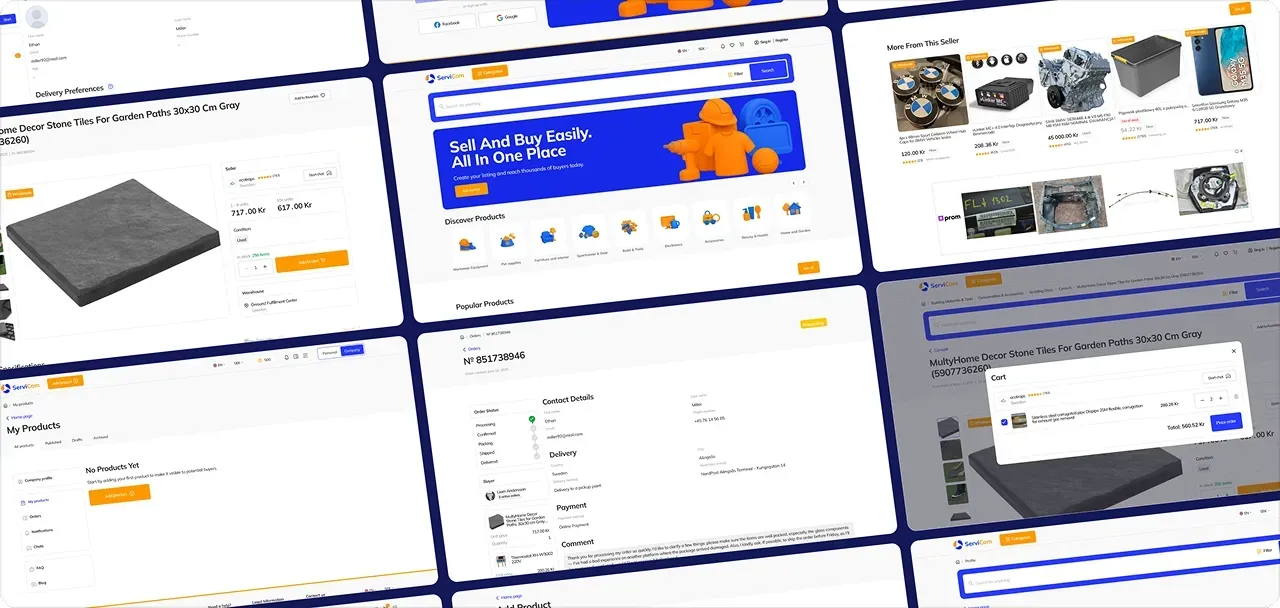
ServiCom is a multi-category online marketplace connecting buyers and sellers in one seamless platform.

Industries
Country

Sweden

Denmark
What we did
E-commerce
·Multi-vendor marketplace
·Real-time / WebSockets
·Scalable Search
·REST API
·Cloud Infrastructure
·Seller Dashboards
Stack
Laravel
·React
·PostgreSQL
·Next.js
·Redis
·WebSockets
·AWS S3
·DigitalOcean
Client
ServiCom is a full-featured online marketplace designed to simplify buying and selling across many product categories — from digital devices and electronics to a wide catalog of general goods. It's a two-sided platform: buyers get search, filtering, and ordering, while sellers get product management, order handling, and their own dashboards. The product's promise is a single place where both sides transact, backed by real-time updates that keep everyone in sync.
Key Highlights
2 account types (buyer + seller) with separate flows and dashboards in one platform.
Multi-thousand-result categories supported by search and filtering (4,345 results in one live category).
Real-time notifications and order updates delivered over WebSockets.
8-part stack integrated end to end — API backend, two frontends, cache, real-time layer, media storage, hosting, and CI/CD.
Challenge
ServiCom needed a marketplace built from the ground up — and a marketplace is one of the harder e-commerce products to get right, because it isn't one store. It's two audiences with opposite needs sharing one system: buyers want to find the right product fast among thousands of listings, while sellers want to manage inventory, orders, and their storefront without friction. Get either side wrong and the platform stalls.
Building that as a new platform set three specific challenges:
- Two-sided complexity. Buyers and sellers needed genuinely separate experiences — accounts, permissions, dashboards, and workflows — running on the same platform without compromising either.
- Search that holds up at scale. With thousands of products across many categories, search and filtering had to stay responsive and precise, or buyers wouldn't find what they came for.
- A backend that can grow. Load grows with every new seller and category, so the architecture had to be extended over time rather than rebuilt each time the catalog expands.
Because it's a transactional platform, performance and dependable infrastructure directly affect the business: when a marketplace is slow or unavailable, buyers can't buy and sellers can't sell. That made a responsive, reliably hosted platform a priority from the start.
Solution
We built ServiCom end to end, structuring the backend into clear modules and choosing each part of the stack to serve scale and a clean two-sided experience:
- A modular backend structure over one undivided codebase. We organized the platform into clear domains — accounts, catalog, orders, notifications — so each can evolve independently and adding sellers, categories, or features doesn't mean reworking everything at once.
- Laravel REST APIs with a React/Next.js frontend. A decoupled, API-driven architecture keeps the buyer and seller experiences flexible on the frontend while one well-structured backend serves both — and Next.js server rendering supports the SEO a marketplace needs to be discovered.
- WebSockets for real-time updates, not manual refreshes. Order status and notifications push to buyers and sellers as they change, so both sides see the current state without reloading.
- Redis to keep the platform responsive as the catalog grows. Caching and in-memory data reduce repeated database load on high-traffic paths like search and listings, helping the experience stay fast as data volumes rise.
- AWS S3 for media, DigitalOcean for hosting, CI/CD for delivery. Product images and assets live in scalable cloud storage, the platform runs on infrastructure that can be scaled with demand, and an automated pipeline ships releases consistently.
On this foundation we delivered separate buyer and seller accounts, product catalog management, advanced search and filtering, shopping cart and checkout, order management, favorites, real-time notifications, and user dashboards.
Process
- Two-sided architecture design — the core decision. Before any features, we defined how the buyer and seller domains would share one system while staying cleanly separated (accounts, permissions, dashboards), because that boundary shaped every module downstream.
- API-first foundation. We designed the REST APIs and backend structure so the two frontends, the real-time layer, and any future integrations all consume one consistent, well-structured source — avoiding divergent logic per client.
- Search & filtering for large categories. We implemented advanced multi-attribute search and filtering and applied Redis caching to high-traffic queries, so browsing stays responsive as categories grow into the thousands of results.
- Real-time layer. We integrated WebSockets for notifications and live order updates across both buyer and seller experiences, keeping state consistent on both sides.
- Infrastructure & delivery — kept as two separate concerns. We deployed on DigitalOcean with AWS S3 for media, provisioning infrastructure that can scale with demand; separately, we set up a CI/CD pipeline for automated, repeatable build-test-deploy, so releases stay safe and consistent as the platform evolves.
Result
- One platform serves both sides cleanly. Buyers and sellers each get their own accounts, dashboards, and workflows — a true two-sided marketplace, not a store with a seller panel bolted on.
- Buyers can browse large categories without the experience bogging down. Advanced search and filtering, backed by Redis caching on hot paths, keeps browsing responsive even in categories with thousands of results.
- Both sides stay in sync in real time. WebSocket-driven notifications and order updates mean buyers and sellers see the current state instantly, without refreshing.
- The platform is built to extend, not rebuild. A modular backend, scalable cloud storage, and a CI/CD pipeline let ServiCom add sellers, categories, and features on a foundation designed to grow with demand.
Technologies: Laravel · REST APIs · React · Next.js · WebSockets · Redis · PostgreSQL · AWS S3 · DigitalOcean · CI/CD Pipeline · Modular backend architecture · Figma.
Related services


Explore more case studies
Explore all
Have a product that needs to impress from the first second?
Premium look and speed don't have to compete. ZentixSoft builds sites that convey the full value of your product - and open instantly on any device.
