Sales Brief Generator
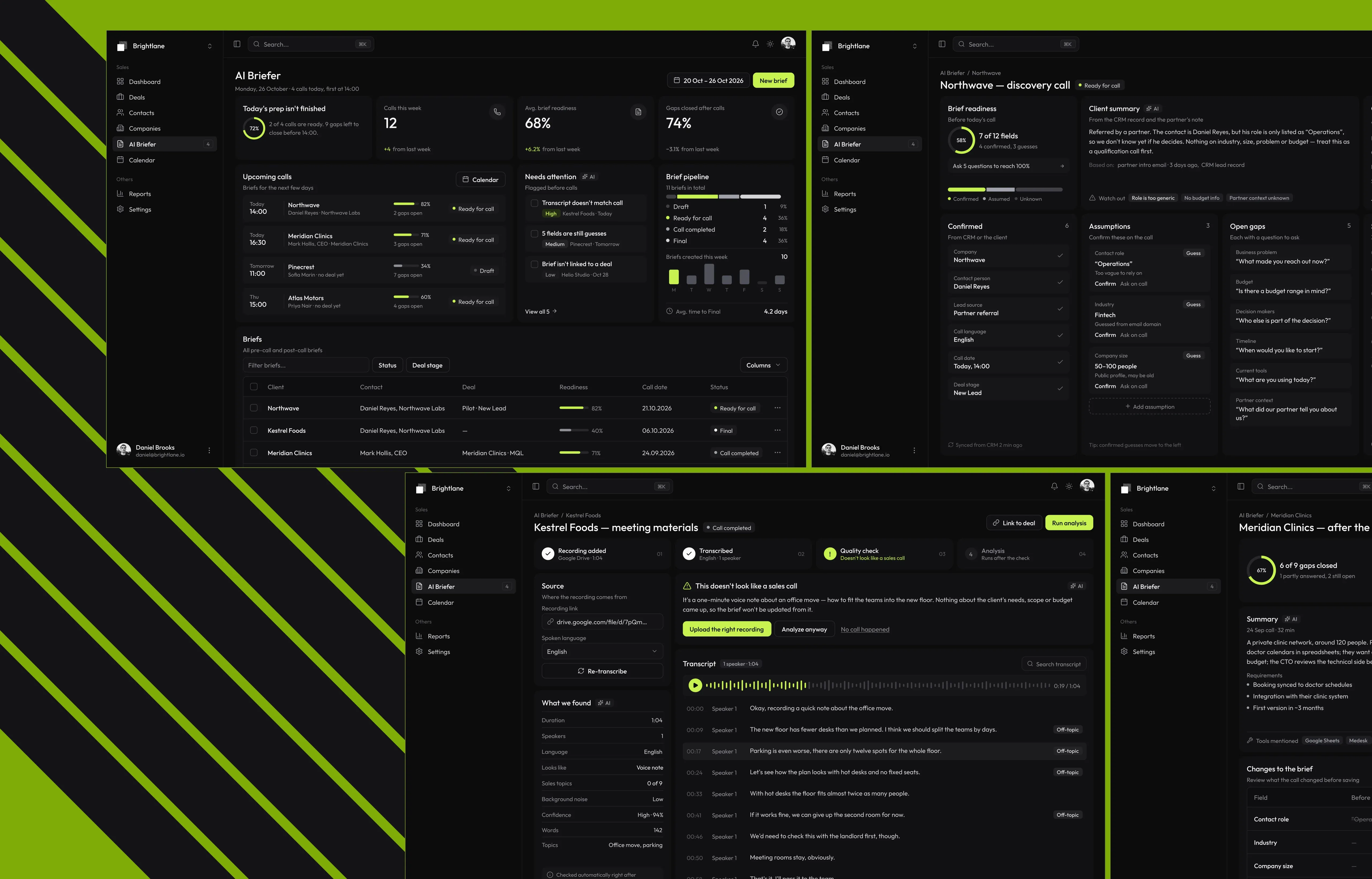
AI Briefer turns discovery calls into approved, 50+ field briefs — one workspace from meeting prep to a CRM-synced record, with the Sales Manager approving every output.

Industries
Country

United States
Services
What we did
Sales
·AI Automation
·AI/ML
·LLM
·Speech-to-Text
·Sales Automation
·CRM Integration
·SaaS
·Workflow Automation
Stack
TypeScript
·Next.js
·React
·Tailwind CSS
·Nest.js
·PostgreSQL
·Prisma
·Temporal
·Redis
·Socket.io
·Python
·faster-whisper
·FFmpeg
·Anthropic Claude
·OpenAI Whisper API
·OpenTelemetry
·Arize Phoenix
·Docker
·GitHub Actions
·Turborepo monorepo
Client
The client is a US-based sales organization that runs a high volume of discovery calls across B2B deals — the kind of consultative selling where each call surfaces requirements, budgets, timelines, and commitments that decide whether a deal moves forward. Those calls produce the most valuable client information in the whole sales process, so the real challenge was everything around them: preparing properly for each meeting, and documenting the client afterwards without losing a detail.
Key Highlights
Call recording → structured brief. Paste a recording link, and calls up to 3 hours are transcribed with live progress.
A brief of 50+ fields in 10 sections, each field marked Confirmed, Assumption, To clarify, or Not applicable.
No silent overwrites. Contradictions with confirmed data are flagged, and manual edits are protected from later AI runs.
CRM integration. Create Briefers from deals, sync approved values, and log call summaries as notes.
Challenge
Discovery calls produce the most valuable client information in sales, yet capturing it consistently is still mostly manual. AI already helped with preparing for calls; after the call, though, people still did the work by hand — reviewing notes, extracting requirements, moving details into internal briefs. The result was predictable: requirements and constraints could stay in personal notes and never reach the brief; brief quality depended on who ran the call; and when a lead came back, the history had to be pieced together from disconnected sources.
The task was to automate the whole path from call recording to reviewed brief — without giving up accuracy or human control.
Solution
The team built a single workspace that connects meeting preparation, transcript analysis, and brief management into one continuous workflow. The key decisions behind it:
- Facts are separated from guesses. The model returns structured JSON, and each field carries a confidence status and a source. Anything unknown stays “To clarify” rather than being filled with a plausible guess — which matters most for budgets, deadlines, and commitments.
- Contradictions are shown, not resolved. New call data is compared with confirmed fields, and any conflict appears to the Sales Manager as “current vs proposed.”
- The human approves. Any field can be edited, and approved values are protected from later AI runs.
- Each job gets the right model. Claude Haiku handles meeting prep and translation — fast, cheaper tasks run at volume. Claude Sonnet handles post-call processing, where the full transcript has to fit in context and the model must follow a strict 50-field schema precisely — so the more capable model is reserved for the step where accuracy and context size actually pay off.
- Client context is isolated. Each AI run receives only its own Briefer’s data, so information from different leads is never mixed.
Process
A team of three (Full-stack, DevOps, PM) built the product in clear stages:
- Discovery & data modeling. We started by mapping the sales discovery flow from first context to approved brief, then modeled workspaces, meetings, and brief fields as separate entities — so the data could be reused and integrated with the CRM later.
- Measuring before building the AI layer. Rather than assume, we measured real calls to size the AI step: input runs ~5k tokens for 17 minutes and ~37k at the 3-hour limit, and output stayed at 5.2–5.7k. Those numbers let us process each call in one pass and set output limits that removed truncated briefs and repeated paid generations.
- Model selection. We tested the work across Claude models and split it by job — Haiku for fast prep and translation, Sonnet for post-call processing where the full transcript and the 50-field schema demand it.
- Building the pipeline. We built the transcription pipeline (hosted lossless Whisper, after compressed audio measurably hurt recognition) and wrapped every AI and transcription run in a Temporal workflow, one per client, so runs can’t overwrite each other and a stalled process reconciles instead of hanging.
- CRM integration. We implemented two-way deal sync — create, link, refresh with a diff, write back, and post notes.
- Hardening, testing & deployment. We added SSRF protection and short-lived signed links, tested across call lengths and edge cases, deployed, and support the product ongoing.
Result
The sales team now has one AI-assisted workflow from meeting preparation to an approved brief:
- One standard brief structure, regardless of who ran the call — a 50+ field record in place of notes that varied by person.
- Client context that survives between meetings, with several calls per lead kept in one workspace.
- Calls focused on open questions instead of repeating information already on file.
- AI output the team can trust — confidence statuses, conflict detection, and human approval built in.
- Client data synced with the CRM instead of copied by hand, so every approved brief flows back to the deal automatically.
Technologies: Claude Haiku · Claude Sonnet · Whisper · Temporal · Two-way CRM integration.


Explore more case studies
Explore all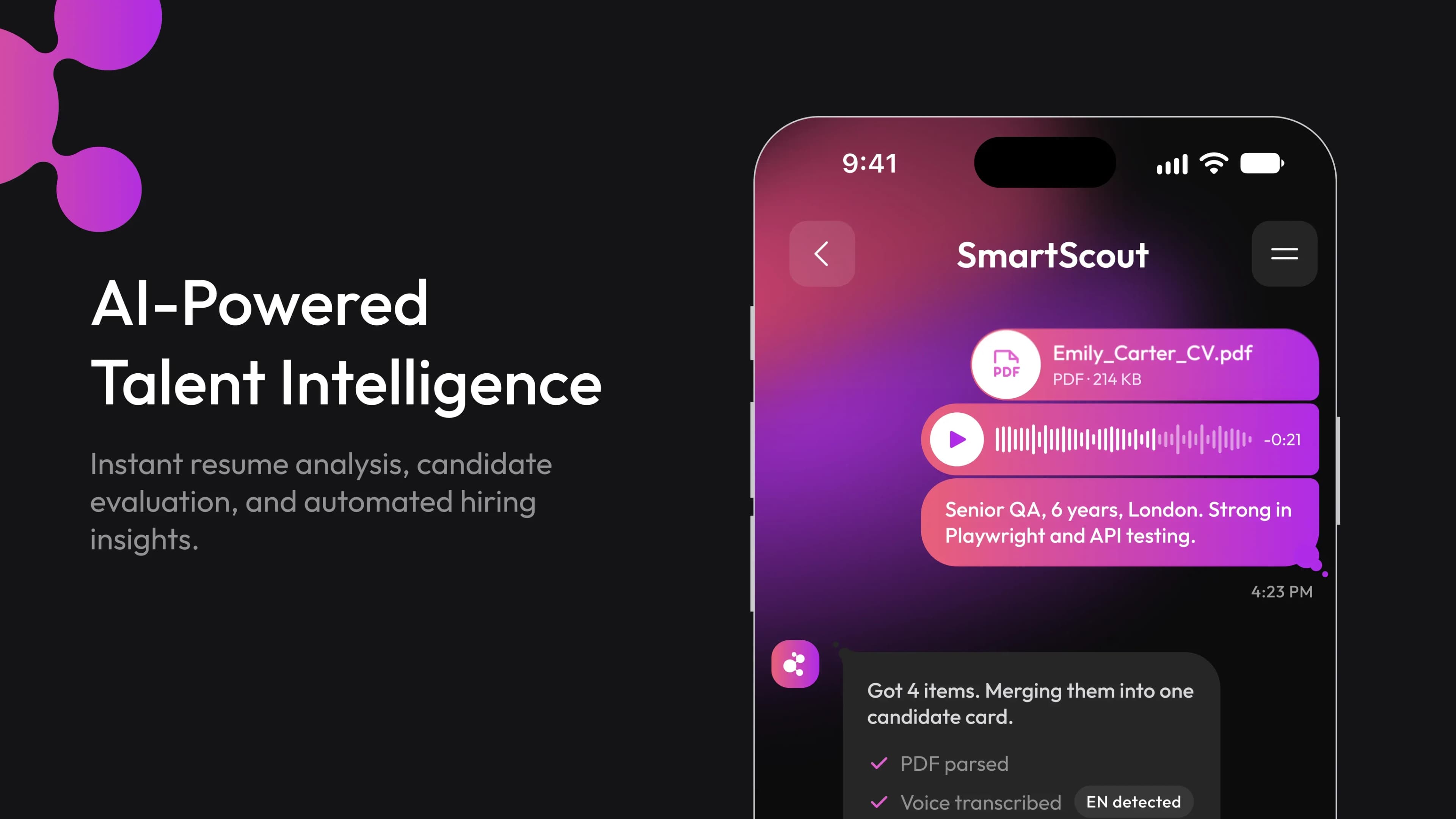
Have a product that needs to impress from the first second?
Premium look and speed don't have to compete. ZentixSoft builds sites that convey the full value of your product - and open instantly on any device.
