HireFlow HRM+AI
AI-powered HRM/CRM discovery with GPT matching, HeadHunter integration, and a roadmap to a talent marketplace.

Industries
Country

Kazakhstan
Services
What we did
HR Tech
·Recruiting & Talent Management
·GPT Matching
·HeadHunter Integration
·ATS
·Talent Marketplace
·Workflow Automation
·Product Discovery
Stack
Laravel
·Vue.js
·OpenAI
·GPT API
·HeadHunter API
·Video & AI Transcription APIs
Client
The client is an executive recruitment and talent-management agency specializing in candidate placement and client relationship management.
Its recruitment operations rely on multiple workflows across candidate sourcing, screening, interviewing, vacancy management, and client communication. The company initiated the project to define a unified internal HRM/CRM platform that could bring those workflows into one system and reduce dependence on fragmented manual processes.
The initial product vision was an internal recruiting platform for the company's own team. The longer-term roadmap included the possibility of evolving the same data and workflow foundation into a two-sided talent marketplace for external clients.
Key Highlights
Architecture planned to support thousands of candidate profiles and future expansion from an internal HRM/CRM into a multi-client marketplace.
GPT-based candidate-to-vacancy matching designed as one of the core planned capabilities.
HeadHunter integration, video interviews with AI transcription, and candidate presentation tools included in the MVP blueprint.
A detailed 6-month MVP roadmap prepared as the output of discovery.
Challenge
The client needed to bring several recruiting workflows into a single platform: candidate sourcing, filtering, matching, interviewing, vacancy management, and client-facing candidate presentation.
Existing tools used by the company did not fully support the combination of integrations and workflows required for its internal recruiting process. In particular, the product needed to accommodate AI-assisted candidate matching, HeadHunter synchronization, video interviewing, and a flexible CRM structure within one system.
A key architectural constraint was also defined early: rather than investing in proprietary machine-learning infrastructure for the MVP, the platform would use existing GPT APIs. This allowed the product architecture to remain focused on recruiter workflows, integrations, and data structure within the planned six-month MVP scope.
Solution
During discovery, we designed a phased platform strategy: first build an internal HRM/CRM around the client's existing recruiting workflows, then preserve the architecture required for a future external talent marketplace.
The solution blueprint included:
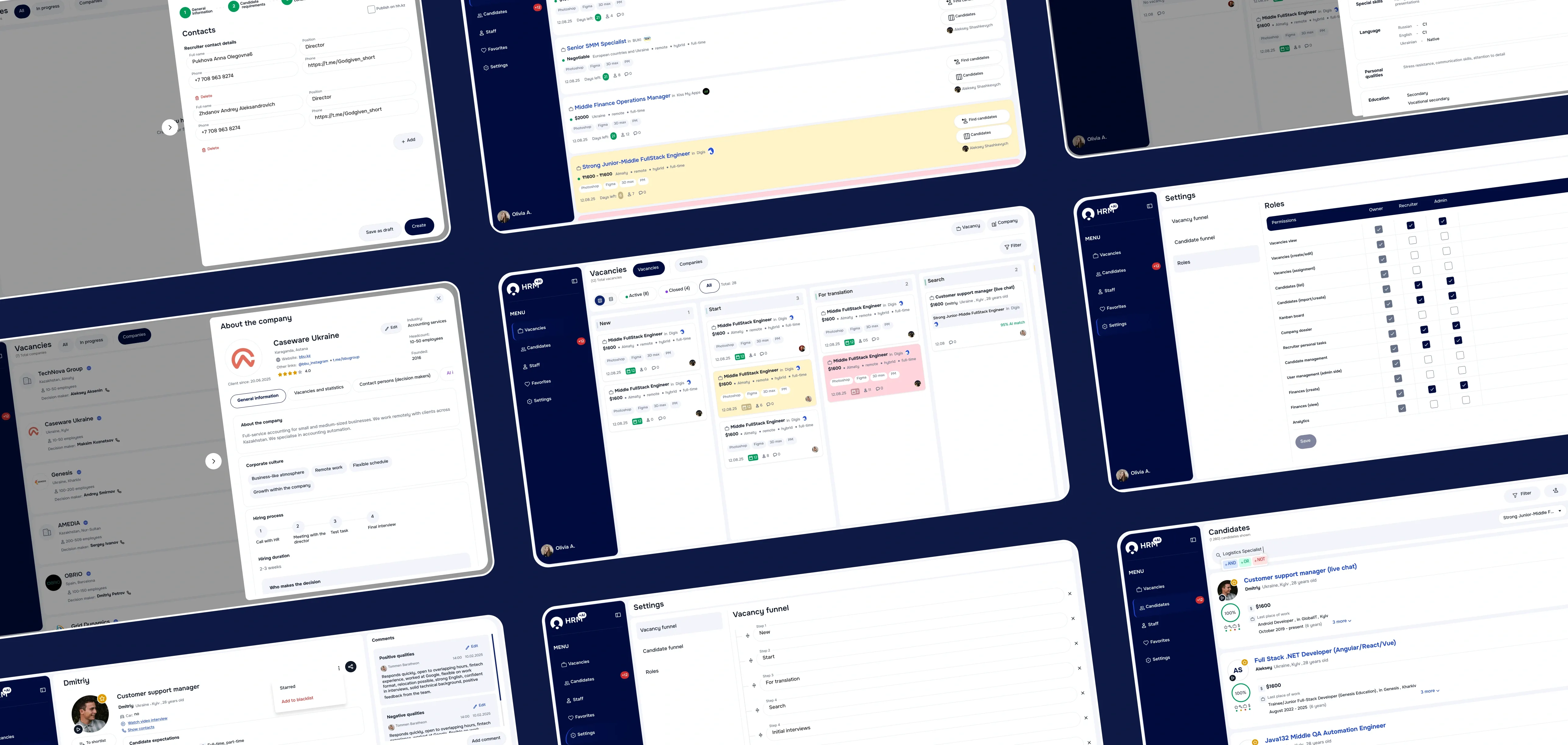
- GPT-powered candidate matching. A planned AI layer for evaluating candidate profiles against vacancy requirements and generating compatibility scores.
- HeadHunter integration. An API integration and familiar filtering experience designed around the sourcing workflows recruiters already use.
- Video interviews with AI transcripts. An in-system interview flow with speech-to-text processing and searchable transcripts.
- Mini-landings and dynamic PDFs. Tools for creating branded candidate profiles and presentation materials for clients.
- Marketplace-ready data architecture. An internal CRM schema designed so candidate and vacancy data could later support external client access.
We also defined several architectural decisions during discovery. HeadHunter synchronization required a caching and data-mapping layer to reduce dependency on third-party API latency and rate limits. Video processing was separated from core application workloads so uploads and transcription would not overload the primary application flow. The AI layer was designed around GPT APIs rather than custom ML models to keep the MVP technically and commercially realistic within the planned delivery window.
Process
We structured the engagement as a four-week discovery and design phase before MVP development.
- Product discovery & requirements mapping. Our Business Analyst and UI/UX Designer mapped recruiter workflows, business requirements, user roles, risks, and core system logic. The team prepared user stories, system documentation, and a six-month MVP delivery roadmap.
- UI/UX design & prototyping. We designed the main recruiter workflows and high-fidelity interface concepts, including candidate navigation and filtering patterns inspired by tools familiar to the client's team.
- System architecture & integration planning. We defined the Laravel-based backend structure, database model, REST API requirements, and integration blueprints for GPT, HeadHunter, video processing, and transcription services.
- Scalability planning. The architecture was structured around the immediate internal CRM use case while preserving a path toward a future multi-client talent marketplace.
Result
The project concluded with a complete discovery package that gave the client a technically defined path from concept to MVP.
- Product discovery, core workflow mapping, UI/UX concepts, and technical architecture completed within 4 weeks.
- A structured 6-month MVP roadmap covering the core HRM/CRM workflows and planned integrations.
- System architecture defined for GPT-based matching, HeadHunter synchronization, video interviews, AI transcription, and candidate presentation tools.
- A data model designed with future marketplace expansion in mind, reducing the need to redesign the core platform if external client access is introduced later.
Because the engagement covered discovery and architecture rather than production deployment, metrics such as recruiter adoption, time-to-hire reduction, uptime, matching accuracy, and cost savings were not treated as delivered results.
Technologies: Laravel · Vue.js · OpenAI / GPT API · HeadHunter API · Video & AI Transcription APIs.


Explore more case studies
Explore all
Have a product that needs to impress from the first second?
Premium look and speed don't have to compete. ZentixSoft builds sites that convey the full value of your product - and open instantly on any device.
