AI Recruiting Assistant
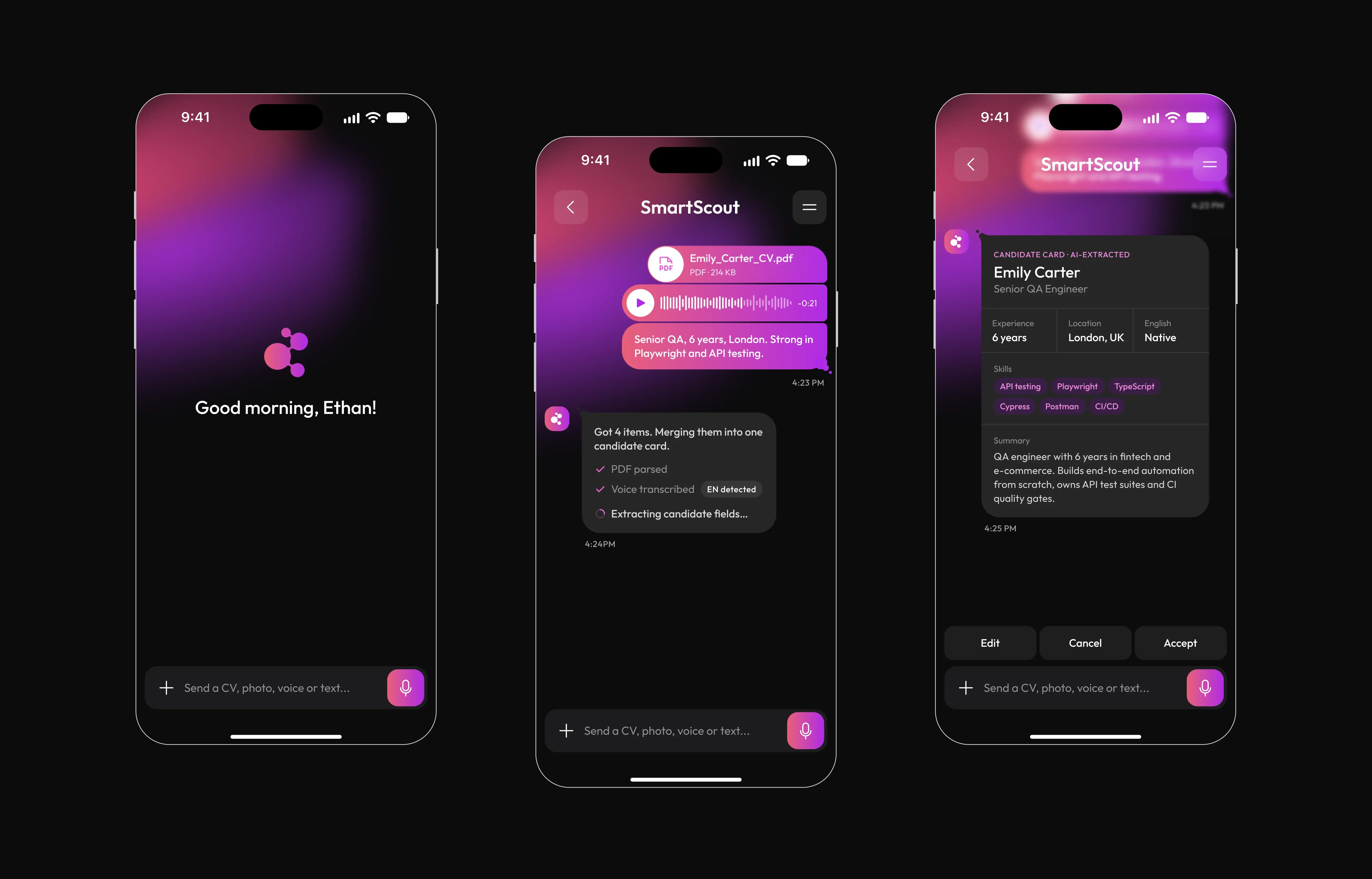
Recruiters forward a CV in any format; the bot returns a structured, duplicate-free candidate record — under human control.

Industries
Country

United States
Services
What we did
HR Tech
·Recruitment
·ATS
·AI/ML
·LLM
·Telegram Bot
·CV Parsing
·OCR / Vision
·Speech-to-Text
·Workflow Automation
Stack
TypeScript
·Node.js
·grammY
·Nest.js
·Temporal
·PostgreSQL
·Prisma
·Redis
·OpenAI GPT-4o
·OpenAI Whisper API
·GPT-4o-mini Vision
·Google Drive API
·Docker
Client
The client is a growing fintech scaling its team quickly — and in high-volume hiring, every manual step compounds. Candidate details reached recruiters in every possible format, and each one meant re-typing information into the database by hand before it could be used. The company wanted to cut that intake time without sacrificing accuracy or control, since the saved data later powers resume generation and AI-powered vacancy matching.
Key Highlights
Any format in, one card out. Files, photos, scans, voice messages, or text, forwarded or sent directly; consecutive messages merge into a single candidate card.
AI extraction built in. Name, position, experience, location, English level, skills, and a summary, pulled automatically in seconds and ready for the recruiter’s review.
The recruiter stays in control. Every card is reviewed and corrected before it’s saved, with safeguards that block empty or unreadable submissions.
Clean, consistent database. Name-based duplicate detection with recruiter-controlled merge, so the same candidate never splits into parallel profiles.
Challenge
The client needed to speed up candidate registration without giving up accuracy, transparency, or control over existing records — a balance that gets harder when the input is unpredictable.
The core challenge was turning messy, multi-format submissions into clean, verified database records, while the recruiter stayed in charge of what gets saved.
Two further requirements shaped the build. Duplicates had to be handled carefully: the same candidate could be submitted more than once, so updating a record needed to merge data rather than overwrite or duplicate it. And intake had to stay cleanly separated from vacancy matching — that’s a different feature — so the bot does one job well and feeds the rest of the pipeline without owning it.
Solution
We built a Telegram bot connected to the client’s candidate database, with every decision aimed at accuracy and recruiter control:
- Why Telegram. Recruiters already live in it, so intake happens where the work already flows — no new app to adopt, no context switch between a conversation and a form.
- Why human review before save. The data feeds resumes and matching downstream, so a wrong field is expensive later. We made the AI propose and the recruiter approve: every card is reviewed, any field is correctable in plain text, and the bot flags files it couldn’t read and blocks a card with no candidate data.
- Why intake is separate from matching. Keeping registration independent of vacancy assignment lets each part evolve on its own — the bot stays simple and reliable, and matching consumes clean data instead of competing for the same code.
- AI-powered processing. Voice is transcribed, documents are parsed, images are read by AI vision, and GPT-4o maps the result onto a fixed candidate schema.
- Recruiter-controlled duplicates. Existing profiles are matched by name and linked in the chat; the recruiter chooses to create a new profile or update the existing one, and updates merge new skills and CV files in rather than overwriting.
Process
A team of three (Full-stack, DevOps, PM) built the product in clear stages:
- Requirements & scope. We mapped the recruiters’ intake routine and the database schema, and fixed the bot’s boundaries — intake only, no vacancy matching.
- Architecture. We designed the pipeline around Temporal, so every submission runs as a durable, retryable session instead of a fragile one-shot.
- Bot & ingestion. We built the grammY Telegram interface and the parsing for each input type — documents, images via Vision, voice via Whisper — with every original file stored in Google Drive.
- AI extraction. We built the GPT-4o extraction against a fixed schema, plus a revision prompt that changes only the fields the recruiter names.
- Validation, duplicates & save. We implemented the review-and-accept flow, name-based duplicate detection with recruiter-controlled merge, and the empty/unreadable safeguards.
- Enrichment, testing & deployment. We added the background CV parse, tested edge cases, containerized with Docker, deployed, and support it ongoing.
Result
- Intake that used to be re-typing is now a two-step flow — recruiters drop in whatever format they received and approve a ready card, instead of converting every document into a standard template by hand.
- Fewer errors reach the database — because recruiters catch missing or mis-captured fields before saving, not after the data is already in use downstream.
- No more parallel profiles — name-based checks and merge-on-update keep one clean record per candidate.
- Every saved profile is ready for what comes next — the bot doesn’t do matching, but its background enrichment hands clean, indexed data to resume generation and the separate AI-matching feature.
Technologies: Telegram Bot · grammY · Temporal · GPT-4o · Vision · Whisper · Google Drive · Docker.


Explore more case studies
Explore all
Have a product that needs to impress from the first second?
Premium look and speed don't have to compete. ZentixSoft builds sites that convey the full value of your product - and open instantly on any device.
