Tender Management Platform
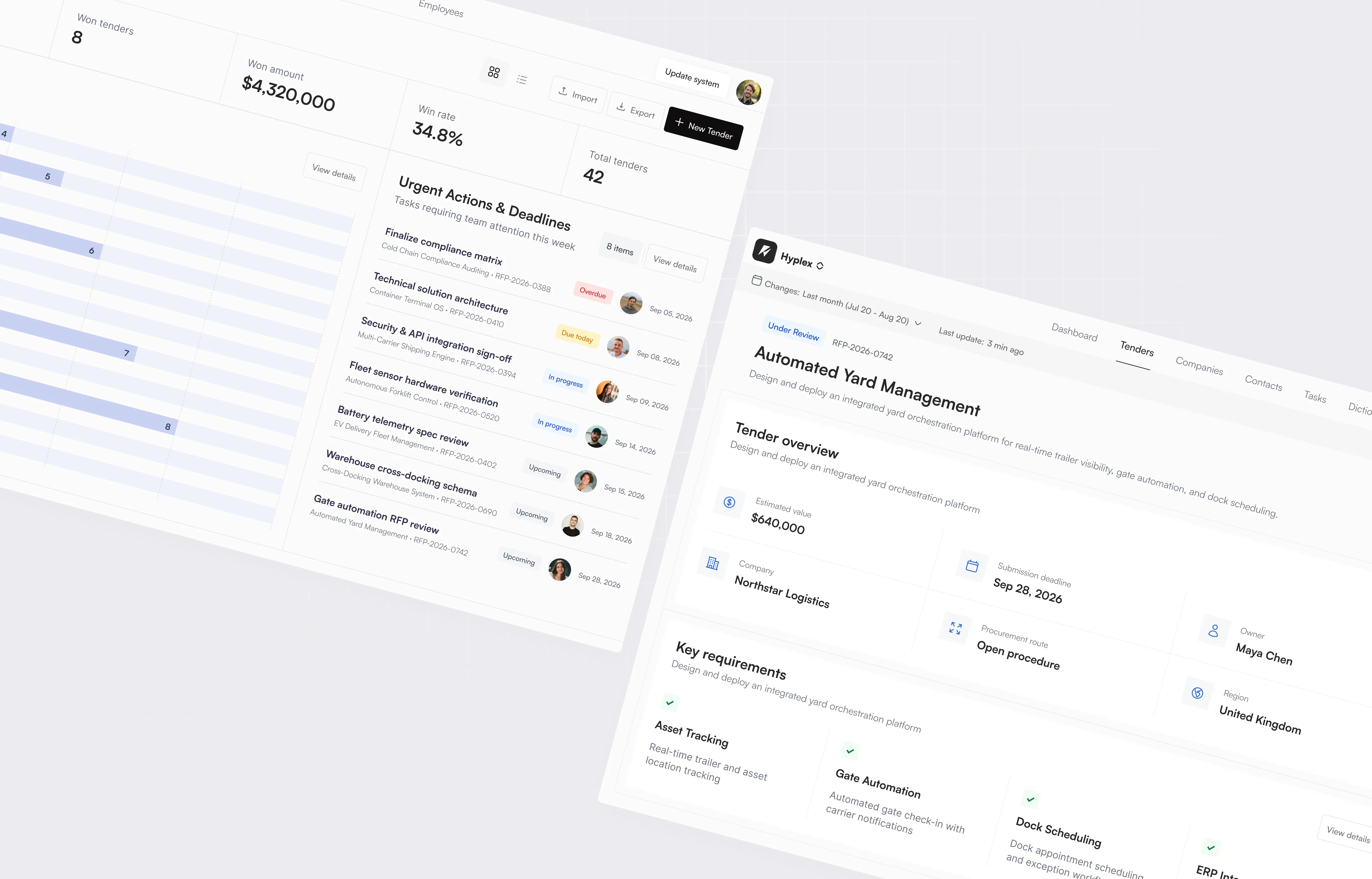
Custom tender management platform for opportunity tracking, stakeholder coordination, and deadline control.

Industries
Country

Germany

United States
What we did
Tender Management
·Procurement
·B2B
Stack
Node.js
·Fastify
·Next.js
·Temporal
·PostgreSQL
·Redis
·RAG
·Docker
·AWS
·Kubernetes
·Microservices
Client
The client is a Logistics & Transportation company whose tender work was spread across separate documents, spreadsheets, contact records, and task lists. As the number of active opportunities grew, the team lacked a single operational view of each tender: its status, responsible people, related organizations, deadlines, and supporting data.
The goal was not to automate tender discovery. The required system starts once an opportunity has already been identified by the team and provides a structured way to register, track, and manage it through the internal workflow.
Key Highlights
6 operational modules covering tender records, stakeholders, tasks, reference data, and management visibility.
Tender records linked directly to companies, contacts, responsibilities, and deadlines.
Standardized dictionaries for consistent tender data across the team.
Google Workspace and AI-service integrations available within the platform environment.
Challenge
The client's problem was operational fragmentation rather than a lack of tender sources. Information about the same opportunity could sit in different files and tools, making it difficult to understand ownership, current status, upcoming deadlines, and the organizations involved without manually reconstructing the context.
- Create one data model. Model tender opportunities that are already identified by the team.
- Link every tender to its context. Connect tenders to the relevant companies, contacts, tasks, and deadlines.
- Standardize reference data. Ensure teams record the same fields consistently.
- Give management a usable overview. Provide visibility without duplicating the underlying operational data.
Solution
We built a dedicated workspace around the client's internal tender-management process. Rather than reproducing another spreadsheet, the platform organizes the relationships between an opportunity, its stakeholders, required actions, and reference data.
- Dashboard. A management view of current tender activity and key operational information.
- Tenders. Structured records for opportunities already identified by the team, including status and tender-specific details.
- Companies & Contacts. Stakeholder records connected to the relevant tenders instead of maintained as separate lists.
- Tasks. Responsibilities and deadlines tied directly to tender records for preparation and follow-up.
- Dictionaries. Controlled reference data that keeps fields and terminology consistent.
Integrations: Gmail · Google Drive · Google Docs · Google Sheets · Google Calendar · OpenAI · Anthropic · OpenRouter · Arize Phoenix.
Process
The work focused on translating the client's existing tender operations into a structured product model rather than applying a generic workflow template.
- Map the relationships. Mapped how opportunities, stakeholders, responsibilities, deadlines, and reference data relate to one another.
- Define the data structure. Defined the data structure and module boundaries for tenders, companies, contacts, tasks, and dictionaries.
- Build the modules. Built the operational modules and linked tasks and deadlines to the relevant tender records.
- Add the dashboard and integrations. Added the dashboard and external integrations required for day-to-day work.
- Deploy and support. Deployed the platform and continued supporting its development.
Result
The delivered platform gives the team one operating environment for the tender-management activities covered by the project.
- Connected records replace scattered sources. Tender opportunities, stakeholders, responsibilities, and deadlines are managed through connected records rather than separate sources.
- Consistent structure. The six core modules provide a consistent structure for the client's tender data and workflows.
- Management visibility. Management can review active tender activity from the dashboard while teams work from the underlying records.
- Room to grow. The platform structure leaves room for additional workflows and integrations as new requirements are defined.
Technologies: Node.js · Fastify.js · Next.js · Temporal · PostgreSQL · Redis · RAG · Docker · AWS · Kubernetes · Microservices.
Related services


Explore more case studies
Explore all
Have a product that needs to impress from the first second?
Premium look and speed don't have to compete. ZentixSoft builds sites that convey the full value of your product - and open instantly on any device.
