How to Evaluate Application Managed Services: 7 Key Metrics
Discover how modern Application Managed Services are measured by business outcomes instead of support hours. Learn the KPIs every AMS provider should deliver.

Outcome-Based Application Managed Services is a collaboration model in which the provider is accountable not for the number of support hours worked or tickets closed, but for concrete business outcomes: system availability, speed of recovery after incidents, and release stability. Companies are shifting to this model because traditional contracts pay only for team activity, creating a conflict of interest between the client and the vendor.
Why Businesses No Longer Evaluate AMS by Hours Alone
The classical model of application management has historically been built on three metrics:
- number of hours worked;
- number of tickets closed;
- formal SLA compliance.
These indicators are convenient to measure, but they don't reflect service quality. A provider can close a hundred tickets a month, and that will do nothing to protect a critical application from failing during peak load.
For application support contracts, hourly billing is a critical flaw. It removes the provider's incentive to prevent incidents, since every new incident generates revenue for them. This is a structural weakness of the model itself, one that remains widespread even in 2026.
Market data confirms the need for change. According to research by KPMG and Gartner, IT outsourcing is shifting from time-based (input-based) to outcome-based payment. The latter approach ties compensation to business metrics and can reduce operating costs by 15–45%, since it motivates the provider to solve problems rather than accumulate hours.
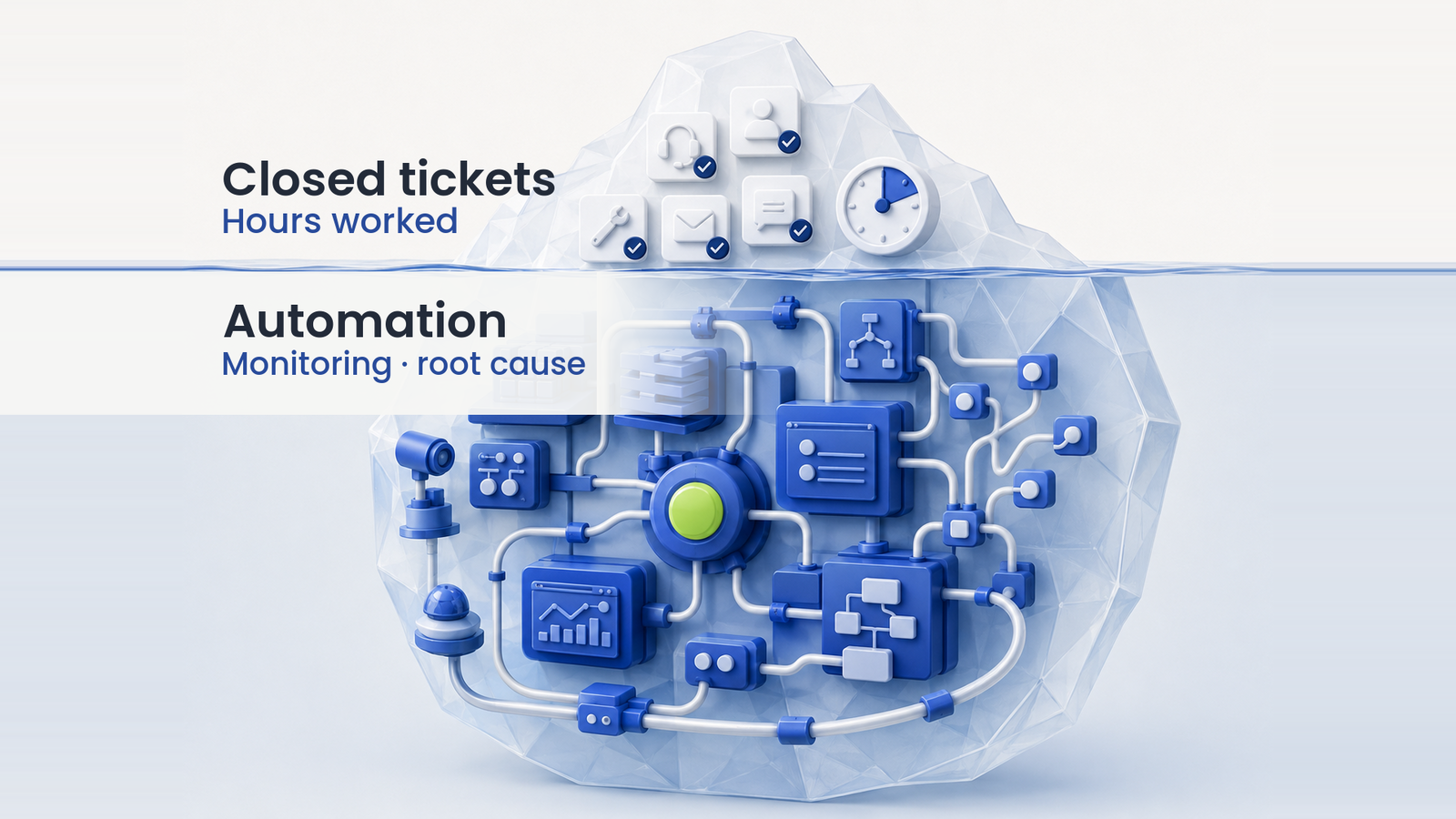
For CTOs and CIOs, the key takeaway is simple: the question isn't whether the model exists, but whether the provider is willing to take accountability for outcomes. Since most contracts are still tied to time or intermediate deliverables, that willingness becomes the decisive criterion for choosing a partner.
What Outcome-Based Application Managed Services Actually Means
Traditional AMS measures the provider's effort, while the outcome-oriented model measures their real value to the business.
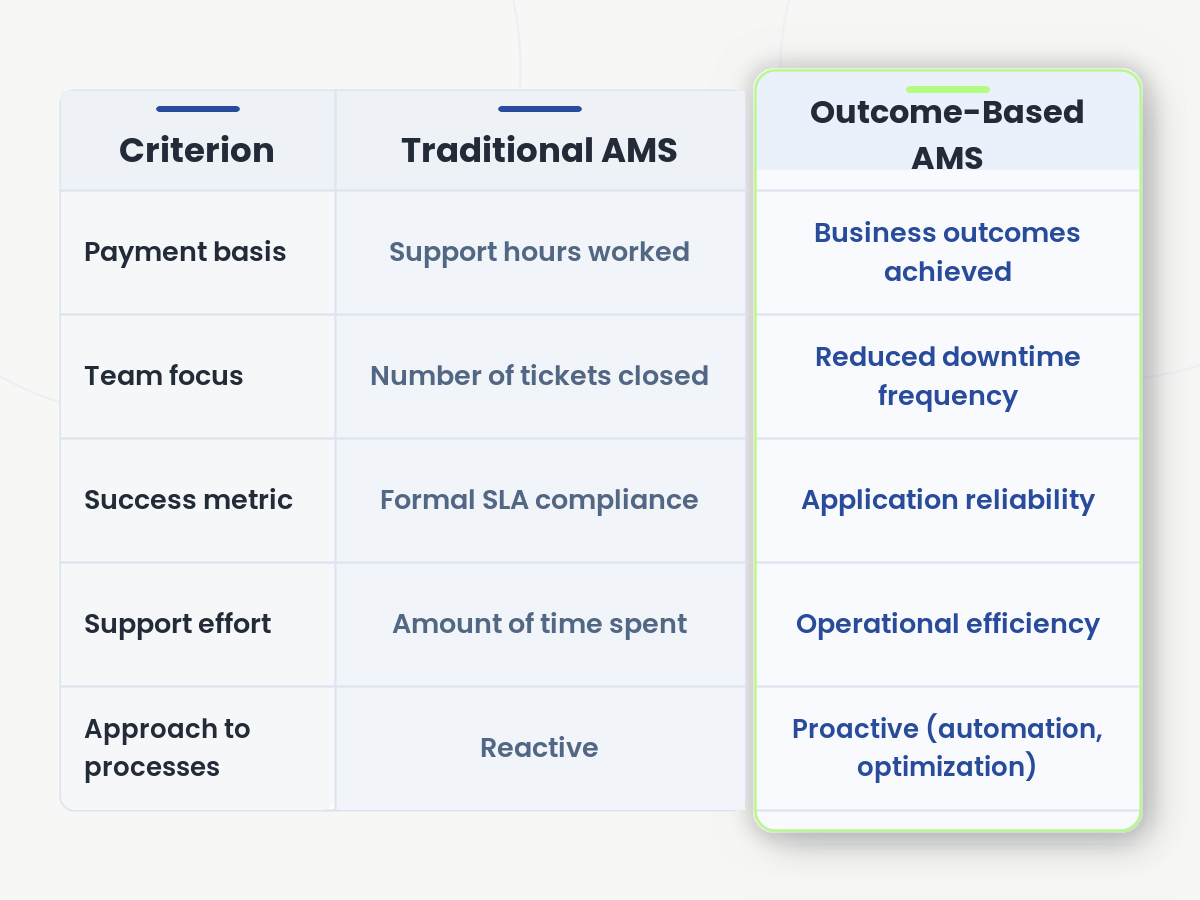
| Criterion | Traditional AMS | Outcome-Based AMS |
|---|---|---|
| Payment basis | Support hours worked | Business outcomes achieved |
| Team focus | Number of tickets closed | Reduced downtime frequency |
| Success metric | Formal SLA compliance | Application reliability |
| Support effort | Amount of time spent | Operational efficiency |
| Approach to processes | Reactive | Proactive (automation, optimization) |
The key difference lies in where the team's attention is focused:
- In the traditional model, specialists are motivated only to close existing requests quickly.
- In the outcome-oriented model, the team aims to minimize the number of incidents and resolve problems automatically — before the business even notices them.
What Results Should You Expect from a Modern AMS Provider?
If you're evaluating a managed services provider based on business outcomes, you need a concrete set of metrics for every application in the company's portfolio — from an internal ERP to a customer-facing CRM.
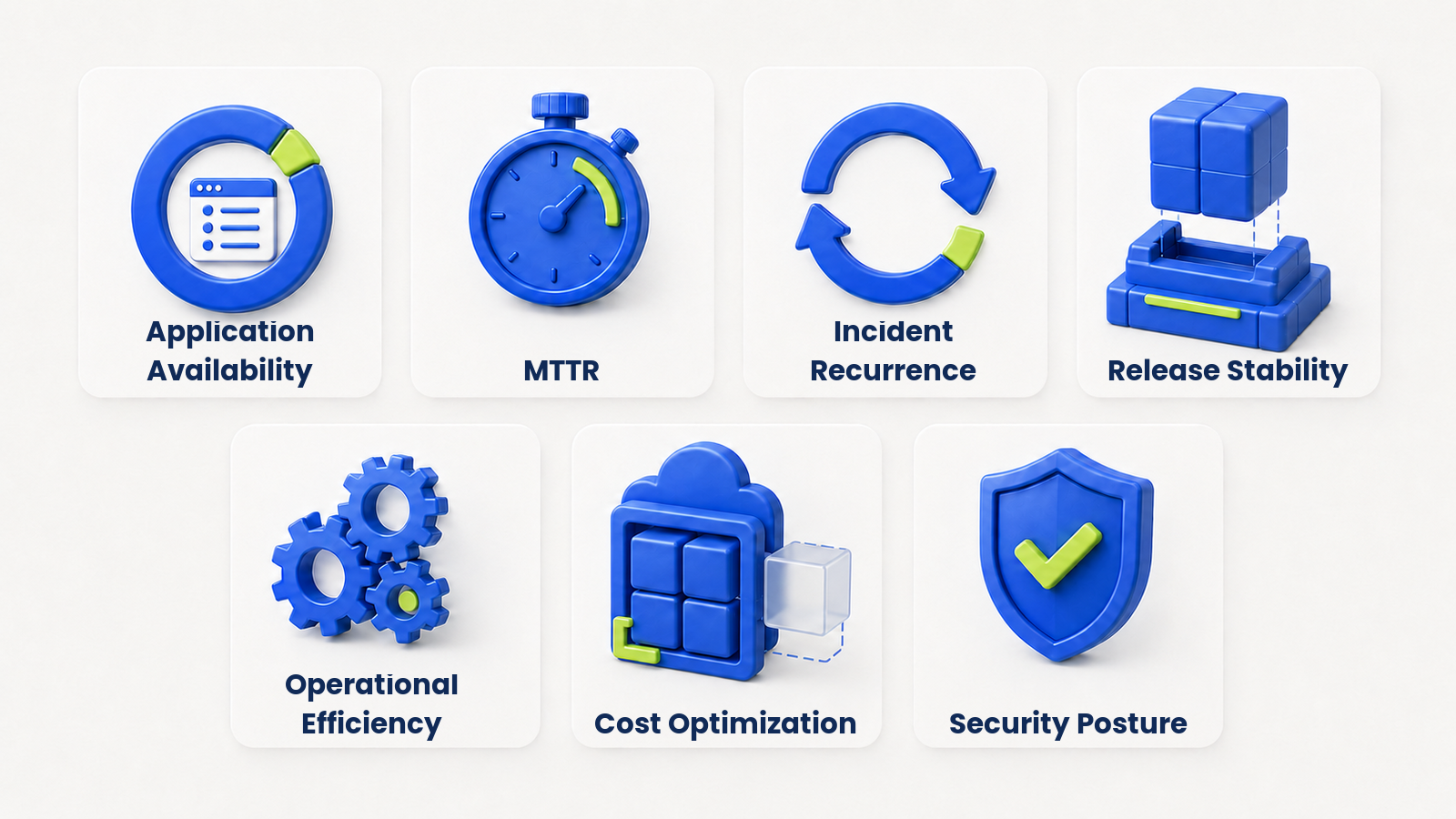
Application Availability
The availability of critical systems during peak hours converts directly into revenue. A reliable provider agrees on a specific availability level (for example, 99.9% or 99.99%) and ensures it through proactive monitoring, regular maintenance, and timely updates.
MTTR
Shows how quickly the team restores an application to a working state after an incident. It's the difference between a micro-outage the business never even noticed and a full-blown incident that halts sales for an hour. Providers with mature processes shorten this time through automated runbooks and clear escalation procedures that kick in before an incident even reaches the on-call engineer.
Incident Recurrence Rate
Indicates whether the team addresses the root cause of failures in the infrastructure and integrations, or simply fights the symptoms each time. A low recurrence index reflects systematic engineering work rather than a routine restart-by-template. Reducing this metric relies on systematic root-cause analysis and a post-mortem practice after every significant incident, where findings translate into concrete changes in architecture or processes.
Release Stability
The percentage of software updates deployed without critical errors. High release stability lets the business roll out new features quickly without risking the stability of the entire system.
Operational Efficiency
The level of automation for routine tasks (backups, patching, monitoring). The less time the team spends on repetitive work, the more capacity remains for architecture analysis, cloud optimization, and system scaling.
Cost Optimization
An assessment of the real total cost of ownership (TCO). Measured by how much the business spends on managing applications per unit of availability, rather than simply by the hours specialists actually work. The provider influences this metric through cloud resource optimization and infrastructure right-sizing — eliminating excess capacity the business pays for but doesn't actually use.
Security Posture & Compliance
Regular security updates and vulnerability monitoring. For regulated industries (finance, healthcare), the SLA should specify concrete timeframes for closing threats, rather than vague promises to do "everything possible." In practice, this means regular patching under a fixed SLA — for example, critical vulnerabilities are closed within a defined number of hours, rather than "whenever there's time."
It's the combination of these metrics — not any single contract clause — that determines how well Managed Services Application actually delivers operational stability, rather than just formal contract compliance.
Questions to Ask Before Choosing an AMS Provider
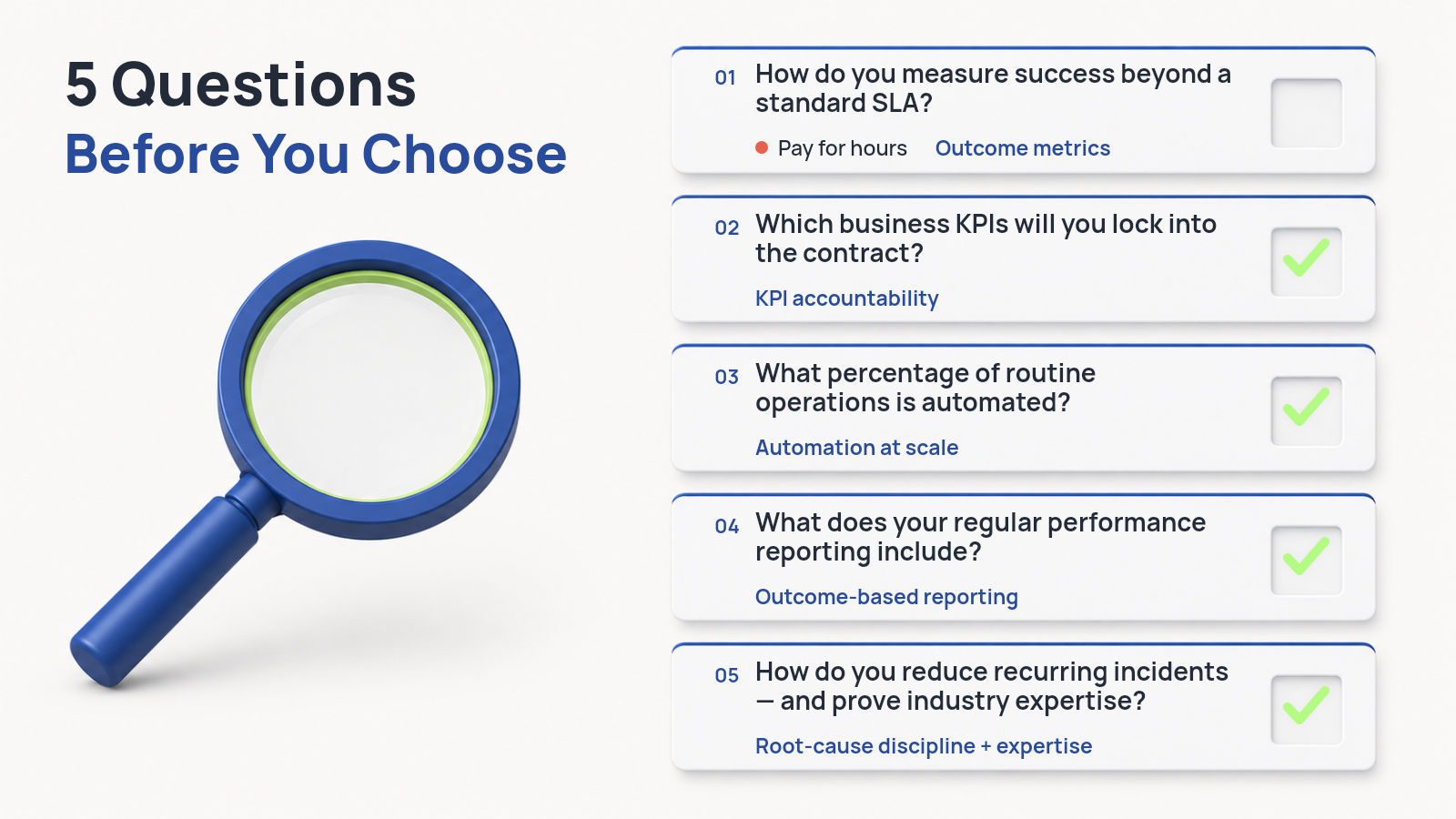
How do you measure the success of our collaboration beyond a standard SLA?
If the answer comes down to nothing more than support response time, the provider is most likely still operating on a "pay for hours" model, even if the word "outcome" appears in the contract.
Which specific business KPIs are you willing to lock into the contract and take accountability for as part of the management process?
A provider's willingness to tie part of the payment to concrete metrics is a direct indicator of their expertise and how serious they are about outcomes within the broader services package.
What percentage of routine operations in your infrastructure is already automated?
A provider that still relies mainly on manual work from each specialist simply cannot deliver scalability without a proportional increase in the management team for every new application — and therefore in cost.
What does your regular reporting on application performance look like?
A breakdown of hours worked is reporting on activity. Analysis of incident trends, MTTR trends, and recommendations on cloud architecture — that's reporting on results.
How do you work to reduce the frequency of recurring incidents, and do you have experience in our industry?
The answer reveals whether the provider has a systematic root-cause analysis process or whether the team simply reacts to symptoms as they arise, as well as how deep their expertise is in the specific industry vertical.
Conclusion
In 2026, evaluating every application within Application Managed Services purely by the number of support hours worked means evaluating process, not outcome. A modern provider should be accountable not for the team's presence, but for measurable indicators:
- system availability;
- speed of recovery;
- release stability;
- reduced incident recurrence.
When choosing a partner for application management and related services, what matters isn't how many support hours they're willing to sell, but which specific outcomes they're willing to be held accountable for — and whether those outcomes are backed by real innovation rather than marketing promises.
