How to Choose a Software Development Partner in 2026
Learn how to choose a custom software development partner: 6 selection steps, 8 evaluation criteria, and red flags to avoid before signing a contract.

Choosing a custom software development partner means evaluating four factors before signing a contract: technical fit, communication process, relevant domain experience, and financial stability. The typical process takes 1–3 months and includes building a shortlist of 10–15 candidates, narrowing it through technical vetting to 3 finalists, and validating the top choice with a paid discovery sprint and reference checks.
A company picks a contractor at the lowest hourly rate. Four months later, the project has stalled: communication is reduced to brief status updates once a week, and the code is understood only by the one developer who just quit. Sounds familiar?
Choosing a custom software development partner comes down to evaluating technical fit, communication process, relevant domain experience, and financial stability — then validating all four through a structured shortlist and vetting process before signing a contract.
According to Mordor Intelligence, in 2026 the software development outsourcing market exceeds $618 billion and, per forecasts, will grow to almost $977 billion by 2031. Given this scale of offerings, many contractors are, at first glance, challenging to tell apart:
- typical case studies on the website;
- standard promises of "expertise" and an "agile approach";
- the same set of technology logos in the "our stack" section.
These surface signals say almost nothing about how a partner will behave under deadline pressure or shifting requirements — and that is exactly what determines the real outcome of the collaboration. Choosing the right partner isn't about intuition or price alone, but a systematic evaluation of experience, processes, communication, engineering maturity, and business fit.
This article covers a step-by-step selection process across six steps, eight evaluation criteria, a practical way to build and narrow a shortlist, and specific risks and red flags.
Why Choosing a Partner Is a Risk Decision, Not a Price Decision
A custom software development partner is a vendor or team that designs, builds, and maintains software tailored to a specific company's workflows, rather than reselling or configuring an existing product.
The most common mistake at the start of the search is comparing contractors by hourly rate, as if it were the main variable. A difference between $25 and $60 per hour doesn't mean a difference in outcome — it means a difference in risks that simply aren't visible at the selection stage. A cheap contractor with a poor communication process and weak QA ends up costing more due to rework, delays, and lost time-to-market.
In practice, "rework" means very specific things: retesting functionality that should have passed QA during the first release or pushing the launch date back by 4–6 weeks because of critical bugs found by users rather than the testing team. For example, an $80,000 project started without an established QA process can easily incur tens of thousands in post-launch bug fixes and lose weeks of market window while a competitor ships a similar feature.
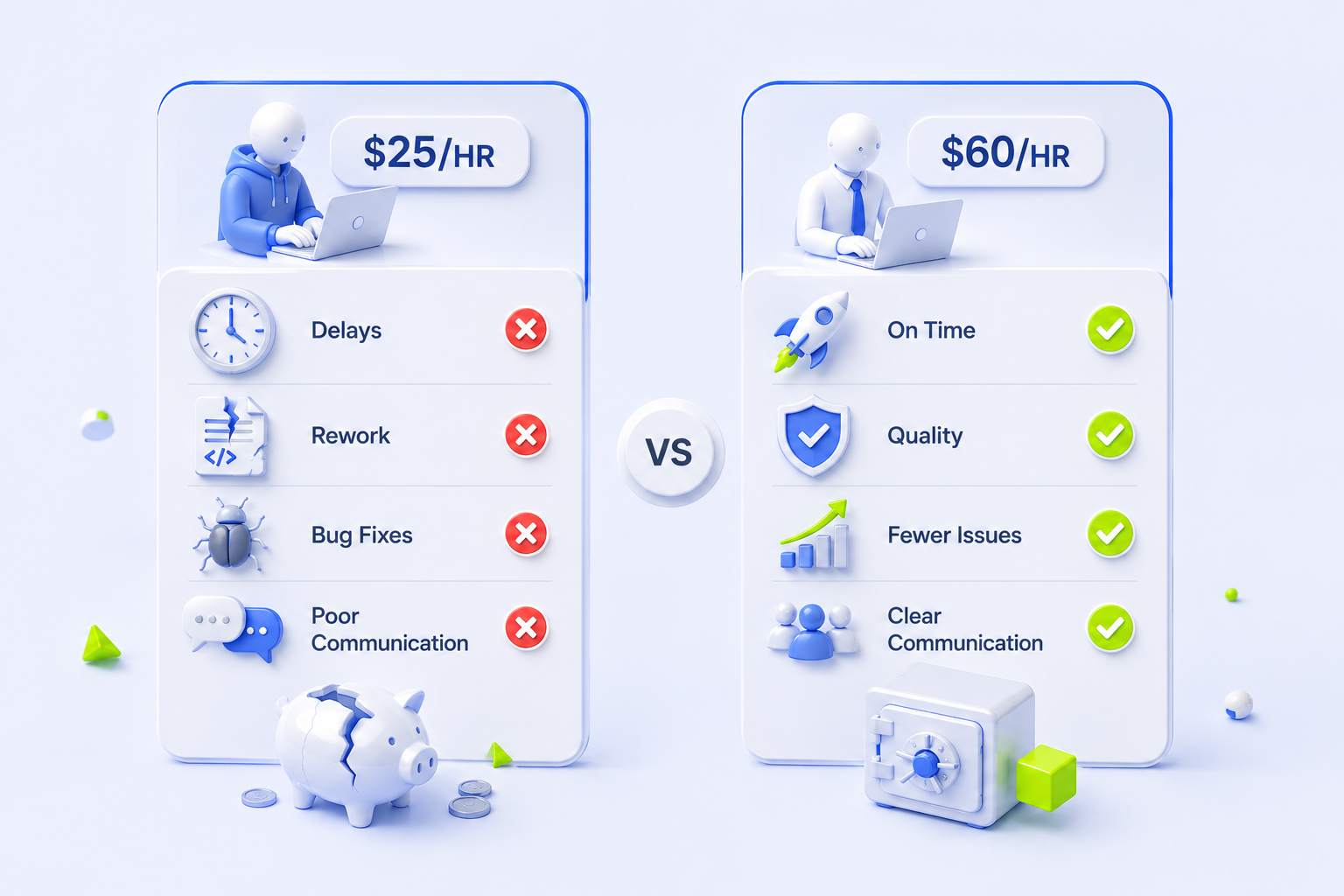
What actually determines the success of a partnership:
- The match between your project's complexity and the team's real experience.
- Process transparency — you understand what's happening at every stage, without having to "beg" for status updates.
- Longevity — a partner capable of supporting the product for years, not just "deliver and forget."
Before moving on, ask yourself one question: "Am I evaluating contractors by what's cheaper, or by what reduces the risk of project failure?" The answer determines how useful the rest of the steps will be.
Next — a step-by-step approach that will help you make an informed choice among dozens of contractors.
The Partner Selection Process: 6 Steps
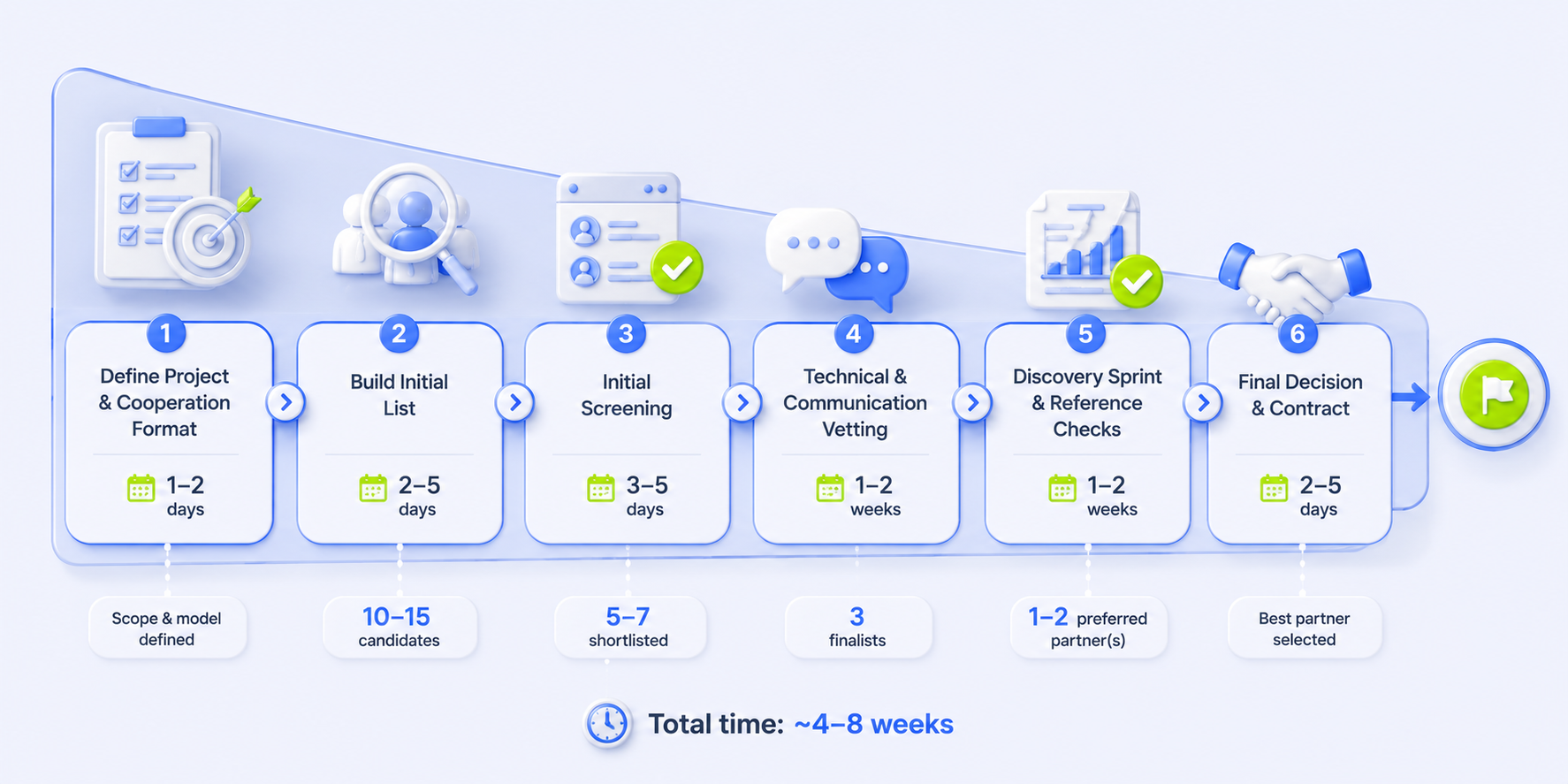
Step 1: Define the Project Type and Cooperation Format Before You Start Searching
Before reaching out to contractors, define the cooperation model:
- Fixed Price
- Time & Material
- Dedicated Team
- Outcome-Based
This immediately narrows the pool of relevant candidates. Outcome-based contracts are becoming increasingly popular, but are not yet a standard, so it's worth asking upfront whether the company works under this model.
Also decide on the partner's geography: a nearshore model helps avoid problems related to a large time-zone difference.
This entire step usually takes one to two business days — and it determines how comparable the proposals you receive next will be.
Step 2: Build an Initial List (10–15 Candidates)
Sources to search:
- recommendations from your network;
- platforms like Clutch or GoodFirms, LinkedIn;
- industry communities.
At this stage, the goal is breadth, not depth. Filtering out candidates too early means risking the loss of a strong partner simply because of a mediocre website.
Step 3: Initial Screening (Narrow Down to 5–7)
Elimination criteria:
- relevant industry experience;
- company size that matches the scale of your project;
- reviews that can actually be verified.
15–20 minutes per company is enough — website, case studies, the team's LinkedIn, mentions online.
Step 4: Technical and Communication Vetting (Narrow Down to 3)
Over the next 1–2 weeks, conduct a call or meeting involving a technical representative from both sides, not just a sales manager from the contractor's side. This is the step where you see what a portfolio doesn't show:
- how the team formulates questions;
- whether they raise uncomfortable clarifications about your scope.
This is also where you assess the partner's engineering maturity — how the following are structured:
- code review;
- QA, CI/CD;
- documentation;
- release process;
- appropriateness of AI use in development processes.
Step 5: Paid Discovery Sprint With 1–2 Finalists
At this stage (usually 2–4 weeks), run a paid discovery sprint. This is becoming increasingly common among experienced software development partners, although it's not yet a universal standard — so it's worth asking whether the company offers this format.
The outcome of the sprint should be a concrete artifact:
- detailed scope;
- architecture and timeline;
- cost estimate, rather than just "an impression from talking."
This gives you the data to make a confident decision — or walk away with minimal losses if the partner isn't the right fit, which is far cheaper than discovering it in the third month of a full-scale project.
Step 6: Validate Finalists and Finalize the Contract
- Check at least two references.
- Compare finalists against the same criteria.
- Make sure the contract describes not just the budget, but also:
- the work process;
- code rights;
- documentation;
- knowledge transfer;
- terms of ending the cooperation.
During the final 1–2 weeks before the project starts, finalize the contract. In particular, specify a concrete term — for example, a minimum of 30 days of knowledge transfer with access to all documentation and infrastructure — that the partner is obligated to provide before the cooperation ends, regardless of the reason for termination.
A good partner doesn't just respond to requirements — they ask clarifying questions, propose alternative solutions, and help improve the product. This is one of the key signs of product thinking, which is what distinguishes a long-term partner from someone merely executing a technical assignment.
Partner Evaluation Criteria
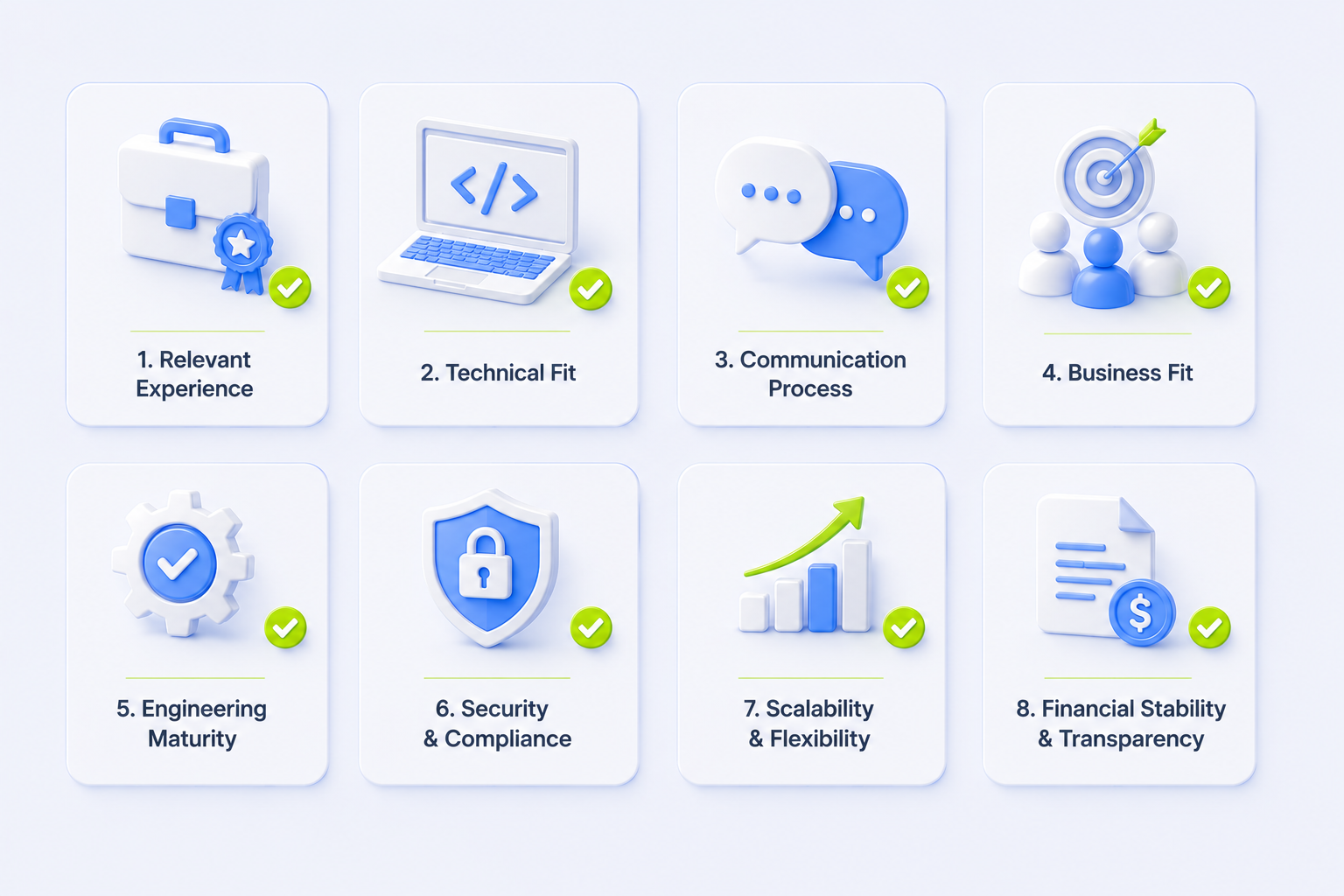
1. Relevant Experience
Does the team have experience with projects in your industry or of similar complexity. Question to ask: "Show me a project as close as possible to ours."
2. Technical Fit
Check the alignment of the technology stack, architecture, and scale of previous projects — an MVP and an enterprise system require wholly different experiences. Question to ask: "Have you worked with a similar load or scale of data?"
3. Business Fit / Company Stage Fit
Assess whether the partner matches the scale of your company and its stage of development:
- startup;
- scale-up;
- enterprise.
Red flag: the contractor serves mostly enterprise clients but positions itself as a "flexible partner for startups" — most likely, its processes are built for long approval cycles rather than fast iterations.
4. Process Transparency and Product Thinking
A good partner doesn't just agree to requirements — they ask clarifying questions and propose alternatives.
Red flag: the contractor cannot clearly describe its work process or unconditionally agrees to any requirements without discussion.
5. Team and Company Stability
Assess the size and structure of the team, the company's track record, the presence of long-term clients, and the stability of the staff. Question to ask: "On average, how many years does key personnel stay with the company?"
6. Communication
Consider time zones, the level of technical English, response speed, and ease of interaction.
Red flag: responses taking longer than 24 hours even at the sales stage — this is almost always an indicator of what communication will be like after the contract is signed.
7. Engineering Maturity
Ask them to show how the core engineering processes are organized. Question to ask: "Show me an example of a pull request or code review from a real project." Using AI can be an additional advantage, but it should complement mature processes, not replace them.
8. IP and Exit Terms
Before the project starts, define code rights, documentation, the knowledge transfer procedure, and the terms for ending the cooperation.
Red flag: the contractor avoids giving a clear answer about the transfer of code rights before the contract is even signed.
How to Build and Narrow Down a Shortlist
The narrowing process logically fits into a funnel: 10–15 candidates → screening based on public data → 5–7 → technical conversation → 3 finalists → reference checks → 1 decision. Keeping more than three finalists in the shortlist at the deep vetting stage is a waste of time without additional value.
A simple comparison table will help structure the decision:
| Company | Relevant Experience | Cost Estimate | Timeline | Communication (1–5) | References Checked |
|---|---|---|---|---|---|
| Vendor A | Yes (2 projects in your industry) | $95,000 | 4 months | 4 | yes |
| Vendor B | No direct experience | $70,000 | 3 months | 3 | no |
After the table, it's worth applying a decision matrix — rating each finalist on a scale of 1–5 against the following criteria:
| Criterion | Vendor A | Vendor B |
|---|---|---|
| Technical Fit | 4 | 3 |
| Relevant Experience | 5 | 2 |
| Business Fit | 4 | 4 |
| Communication | 4 | 3 |
| Process Maturity | 5 | 3 |
| Cost | 3 | 4 |
In this example, Vendor A is pricier and slightly slower, but significantly stronger in experience and process maturity; Vendor B is cheaper but has no relevant industry experience. The weighted total score helps reveal which trade-off is actually justified, instead of the intuitive "the cheaper option seems fine."
The final weighted score helps you decide more objectively than comparing on price alone.
Two typical mistakes at this stage:
- Comparing finalists only by price proposal, ignoring the qualitative criteria from the previous section.
- Expanding the shortlist back to 6–7 candidates out of uncertainty — this is a sign that the selection criteria at the previous step were unclear.
The timeframe from the initial search to signing the contract is usually 1–3 months for a mid-sized project. For enterprise projects, the process can stretch to six months, while a small SMB project may take just a few weeks.
This spread is explained not so much by the complexity of the product itself as by the number of stakeholders involved in the decision: where finalizing the contract is agreed upon by a single founder, the cycle is shorter than where the decision has to pass through legal, financial, and technical departments. Trying to artificially compress this cycle to a few days is itself a risk factor.
Risks of Choosing the Wrong Partner and Red Flags
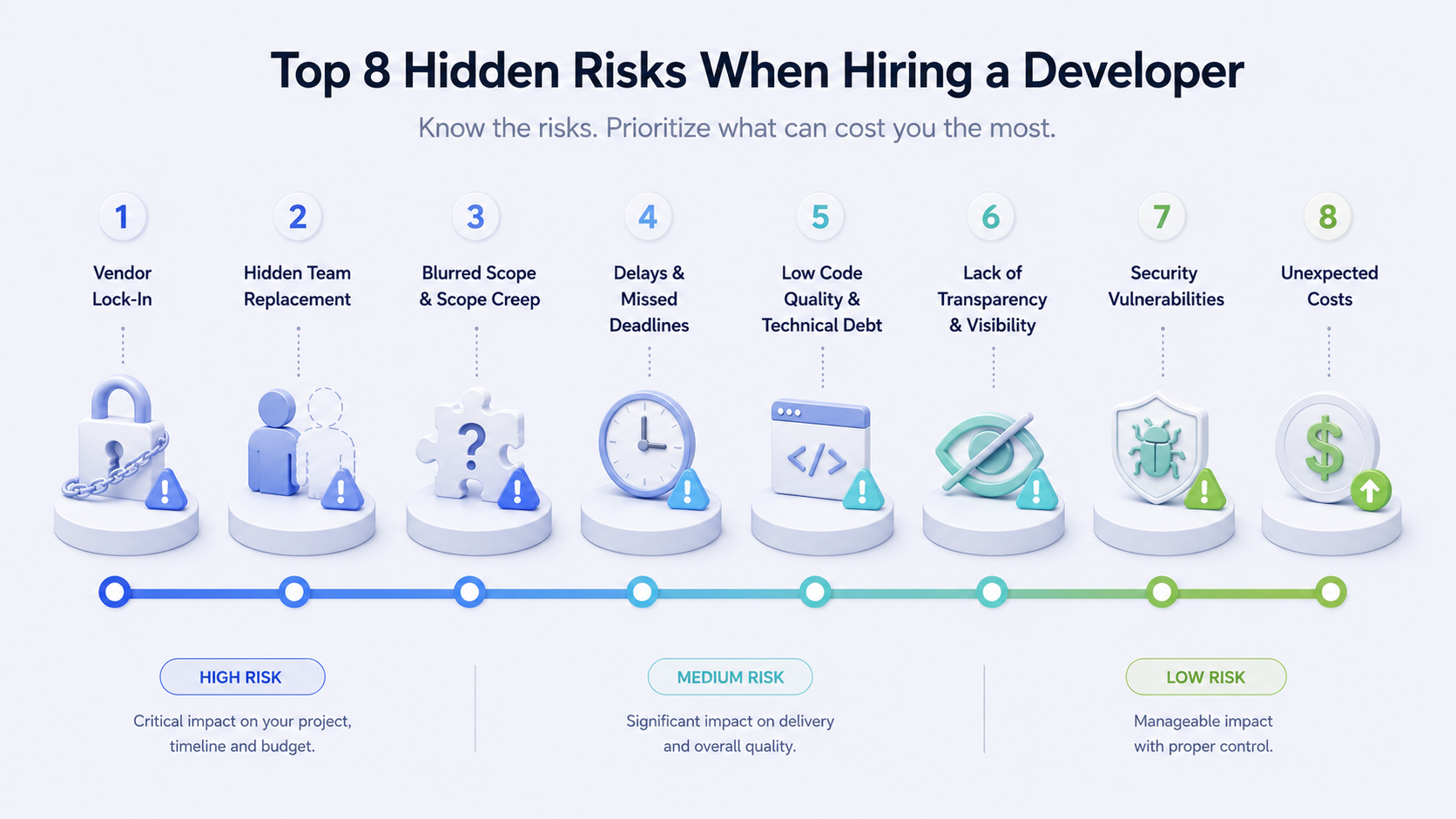
8 common threats when choosing a software development partner:
1. Vendor Lock-In
Lack of documentation and knowledge transfer makes it difficult to change contractors in the future. Check examples of technical documentation before starting the cooperation.
2. Hidden Team Replacement
The bait-and-switch practice: after the contract is signed, senior specialists are quietly replaced with less experienced ones. Lock the team composition or minimum seniority level into the agreement.
3. Blurred Scope
Unclear requirements lead to constant growth in budget and timelines, even in Time & Material projects. Before starting, agree on a minimally sufficient scope of work and success criteria.
4. Insufficient Engineering Maturity
If the company lacks mature processes for code review, QA, CI/CD, documentation, or release management, the risk of costly mistakes and technical debt increases significantly. Ask the partner to describe their development and quality assurance process in detail.
5. Unvetted Vendor
Lack of verified references, an opaque company history, and the inability to talk to previous clients or meet the future team are serious red flags. Verify public reputation, case studies, and reviews before making the final choice.
6. Communication Problems
A significant time-zone difference, slow responses, or an unclear interaction process can significantly slow down development. Agree in advance on communication channels, responsible people, and the format of regular reporting.
7. Undefined Code Rights
Before signing the contract, define the rights to the code, documentation, work results, and the terms for project handover. This significantly reduces potential problems during the end of the cooperation or a change of contractor.
8. AI Hype Instead of Engineering Expertise
In 2026, most contractors already use AI, so simply mentioning it says nothing about the quality of the partner. Ask them to show how AI is integrated into mature engineering processes (code review, testing, documentation) and what measurable results it delivers.
Good answer: "We use an AI assistant to generate test cases, which cut unit test writing time by about 20%, but every pull request still goes through mandatory human review" — meaning AI complements the process rather than replacing quality control.
Bad answer: generic phrases like "we're an AI-first company" without any specific examples or metrics.
None of these risks are unique or rare — each of them occurs regularly precisely because it surfaces only after the contract is signed, when the options for resolving the problem cost significantly more than preventing it in the first place.
Most of the red flags listed above can be checked during steps 3–5 of the selection process described earlier: the technical conversation, the paid discovery sprint, and reference checks cover almost this entire list before any money changes hands.
Conclusion
The right development partner isn't the one with the best portfolio or the lowest rate. It's the one whose processes, team, and incentives are structured to systematically reduce your project's weak points.
If you haven't started your search yet, don't start with Google — start with a clear definition of the scope and the cooperation model. That's Step 1 of the framework above. This is where the foundation for comparable proposals is laid.
Build your shortlist using the comparison criteria above before your first sales call — it will save you weeks of unnecessary back-and-forth and meetings that add nothing to the decision.
