Custom Software vs Off-the-Shelf: Real Cost Comparison
Custom software or off-the-shelf SaaS - which actually costs less over 5 years? Decision framework, TCO comparison, and 4 real-world cases with numbers. Updated for 2026.

What is the difference between custom and off-the-shelf software? Off-the-shelf is a ready-made product sold to thousands of companies — Salesforce, Shopify, QuickBooks. Custom software is built for one organization's specific processes. Off-the-shelf wins on speed and upfront cost; custom wins on long-term TCO and control. The right choice depends on process uniqueness, planning horizon, and scale — and the 5-year total cost often tells a different story than the entry price.
Introduction
An e-commerce company was paying $96,000 a year for a SaaS platform to manage its orders — until it ran the numbers and found that 40% of the features sat unused. A business-critical, everyday workflow for custom wholesale-client discounts didn't exist in the system at all.
Custom software gives you full control and long-term cost efficiency. Off-the-shelf gets you to market faster with lower upfront investment. The right choice depends on three factors: process uniqueness, time horizon, and scale.
What follows is a decision framework, a 7-criteria comparison, real-world cases (in both directions), and a checklist.
The Decision Framework: Where Does Your Business Fall?
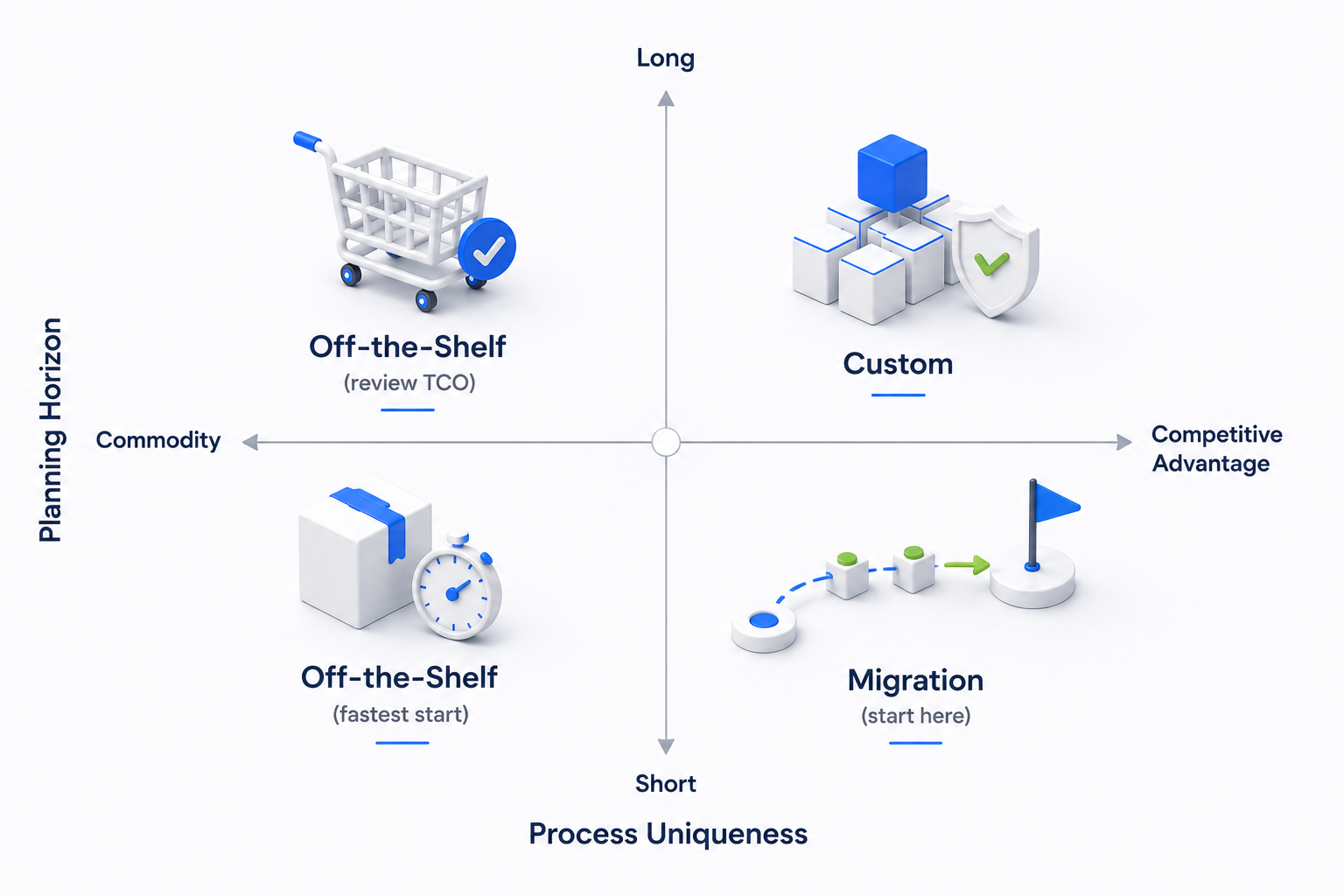
Before we dive into the numbers and the details, let's look at the underlying model that will help you make sense of everything that follows. It rests on two axes:
- X-axis — process uniqueness: from a commodity function (a standard task that thousands of companies solve the same way) to a competitive advantage (unique logic that translates directly into revenue).
- Y-axis — planning horizon: from short (< 2 years) to long (5+ years).
This gives you four reference points:
- Commodity + short horizon — off-the-shelf, no question.
- Commodity + long horizon — off-the-shelf, but with a regular annual TCO review.
- Competitive advantage + short horizon — off-the-shelf at the start, with a migration plan to custom once processes stabilize.
- Competitive advantage + long horizon — custom development pays off more often — but only if the process is already stable, not changing month to month.
We'll break down each section in detail below, so you can clearly identify which quadrant you fall into.
What Is the Difference Between Custom and Off-the-Shelf Software?
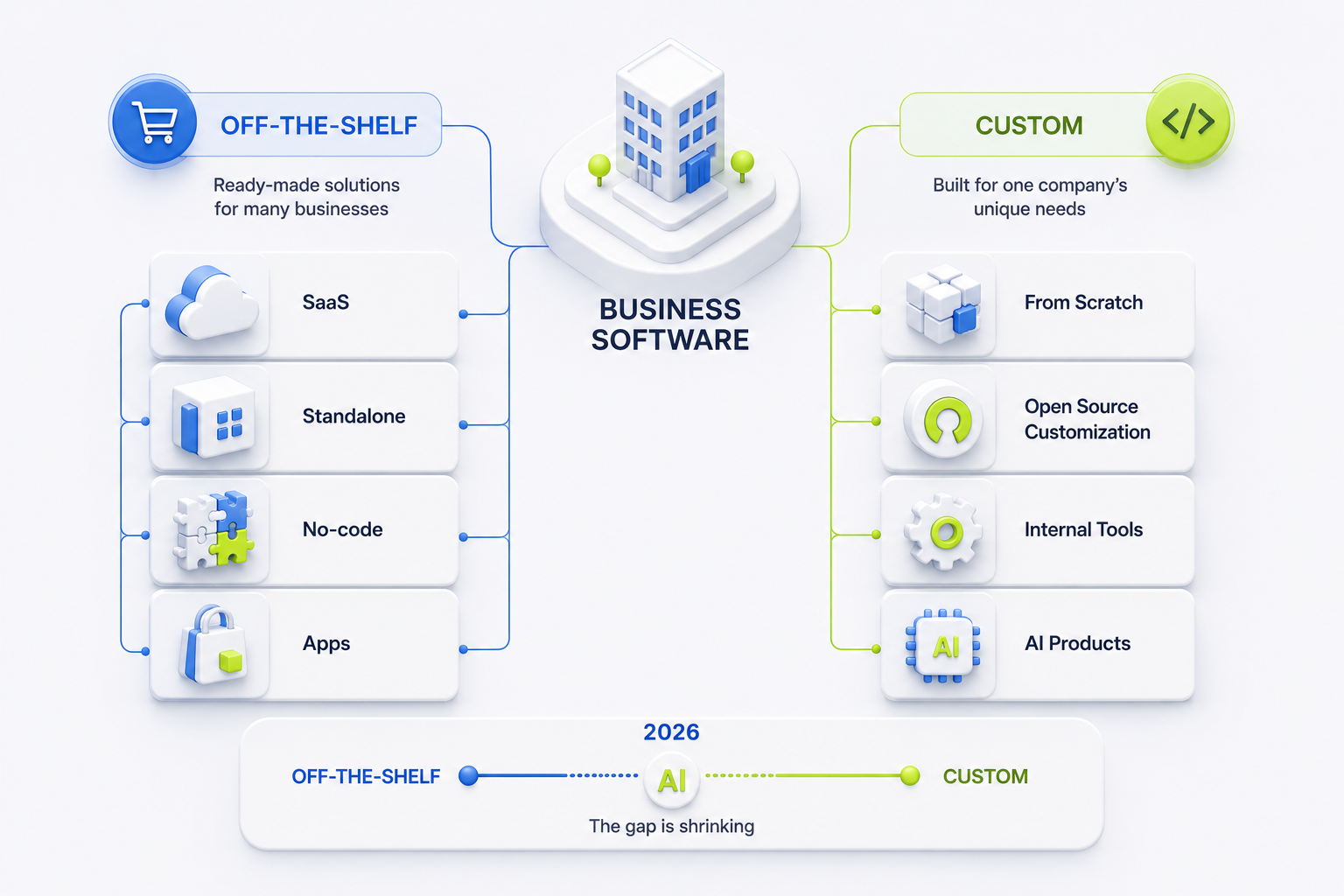
Off-the-shelf software is a ready-made solution sold to multiple businesses with standardized features — a product with identical logic for thousands of customers.
Custom software is built specifically for one organization's unique requirements — a solution built around one specific company's processes.
What falls under off-the-shelf
- SaaS platforms — Salesforce, HubSpot, Shopify.
- Standalone software — Microsoft Office, QuickBooks.
- No-code/low-code with customization — Webflow, Bubble.
- Marketplace apps with ready-made plug-and-play logic.
What falls under custom software
- Development built from scratch around a specific business process.
- Customization of open-source solutions — Odoo, Mautic.
- Internal tools for specific operational tasks.
- AI-powered products with their own proprietary logic.
In 2026, the line between the two approaches is blurring — but in both directions. AI tools (Cursor, Copilot, Claude) significantly speed up routine development tasks — code generation, testing, refactoring — which lowers the barrier to going custom. But that applies specifically to routine tasks, not to complex, turnkey AI products: research from MIT Project NANDA shows that companies buying ready-made AI solutions from specialized vendors succeed roughly twice as often as those building AI functionality in-house from scratch.
In other words, AI accelerates custom development for classic business software, but it doesn't remove the risk for complex AI initiatives, where "build" historically fails more often than "buy."
Custom Software vs Off-the-Shelf: Comparison by 7 Criteria
Key differences between the two approaches:
| Criteria | Off-the-Shelf | Custom Software |
|---|---|---|
| Cost | Low upfront cost, risk of overpaying long-term | High upfront investment, predictable costs |
| Time to launch | Weeks | Depends on complexity — months |
| Flexibility | Limited, breeds a workaround culture | Full flexibility, but risk of architectural debt |
| Scalability | Licenses scale with users/seats | Scales on its architecture |
| Integrations | Ready-made connectors, but API limits | Full freedom, every integration is its own project |
| Security | Vendor's responsibility | Your responsibility |
| Ownership | Rented, vendor controls roadmap and pricing | IP and data fully yours |
1. Cost
Off-the-shelf wins on upfront cost, but a subscription multiplied across years and team growth often ends up exceeding the cost of custom. Custom requires a large initial investment, but predictable costs after launch — provided you scoped it correctly. The right comparison isn't entry cost, but 3–5 year TCO — calculation below.
Threshold: if your subscription is tied to users/seats and your team is growing, calculate TCO now, not when the bill surprises your CFO.
2. Time to launch
Off-the-shelf can be up and running within a few weeks. Custom depends on complexity: a simple internal tool — 2–4 months, a mid-complexity product with integrations — 5–9 months, enterprise-level — 10–18+ months. AI-assisted development shortens this timeline for routine components, and an MVP phase takes some pressure off speed overall.
Threshold: if you're under a hard deadline, speed matters more than ideal architecture. Start with off-the-shelf or an MVP, and build custom later.
3. Flexibility
Off-the-shelf confines you to the vendor's framework, which over time breeds a workaround culture. Custom gives you full flexibility, but without clear planning it risks turning into technical debt.
Threshold: if your team spends more than a few hours a month working around platform limitations, that's already a hidden cost worth comparing to the price of custom development.
4. Scalability
Off-the-shelf scales by licensing model: more users or storage means a direct, often disproportionate, increase in your bill. Custom scales on its architecture, but requires engineering decisions made in advance.
Threshold: up to 20–30 users, the price difference is usually not critical. Past 50+, SaaS licensing becomes one of the largest line items in the budget.
5. Integrations
Off-the-shelf comes with ready-made connectors, but you're at the mercy of the vendor's API limits. Custom gives you full freedom to connect anything, but every connection has to be built yourself.
Threshold: at 3–5 integrations, ready-made connectors are typically simpler. At 10+ interdependent services, the complexity of a no-code stack often exceeds that of building a single custom solution.
6. Security
With off-the-shelf, responsibility sits with the vendor — which takes the operational burden off you, but you don't control where your data is stored. With custom, you're responsible yourself — both a risk and an advantage.
Threshold: if your industry is regulated (HIPAA, PCI DSS, GDPR), check whether the vendor provides the compliance you need. If not, custom becomes a question of legality, not just preference.
7. Ownership
With off-the-shelf, you're renting the functionality. The vendor can raise prices, change the roadmap, or shut down — and you won't have an alternative. This isn't a theoretical risk: in 2026, many SaaS vendors introduced an "AI surcharge" — a 20–37% price increase at contract renewal from bundling AI features into packages that used to cost less. The same "cost predictability" off-the-shelf has been promised for years is now under pressure, precisely where the vendor decides to add AI functionality to your plan.
A new risk in 2026: shrinkflation. Beyond overt price hikes, approximately 60% of SaaS vendors now also practice shrinkflation — reducing the value of existing tiers without lowering the price. This means cut technical support, tightened SLAs, or removed features at the same historical base price. A 7% renewal price increase combined with feature reduction can deliver an effective cost increase of 15–25% when your team has to purchase add-ons to restore previous functionality. Factor this into your TCO calculation.
Threshold: if the process you're building on someone else's platform is part of your competitive advantage, vendor lock-in means that advantage legally belongs to someone else.
Which Companies Should Choose Custom Development?
Off-the-shelf is your choice if
- You're an early-stage startup, and the main priority is validating an MVP quickly.
- The process is standard and not a competitive advantage — HR, accounting, basic bookkeeping.
- Your budget is limited, and you don't have a technical team to maintain a custom solution.
- The problem is well-solved by a product with proven market fit — email marketing, CRM for small businesses.
Custom is your choice if
- The business process is your competitive advantage — unique logic that translates directly into revenue.
- You operate in an industry with specific regulatory requirements — healthcare with HIPAA, fintech with PCI DSS.
- Scale makes SaaS subscriptions economically irrational — typically past 50+ seats.
- You need full control over data, security, and the product's intellectual property.
When Does Off-the-Shelf Become a Limitation?
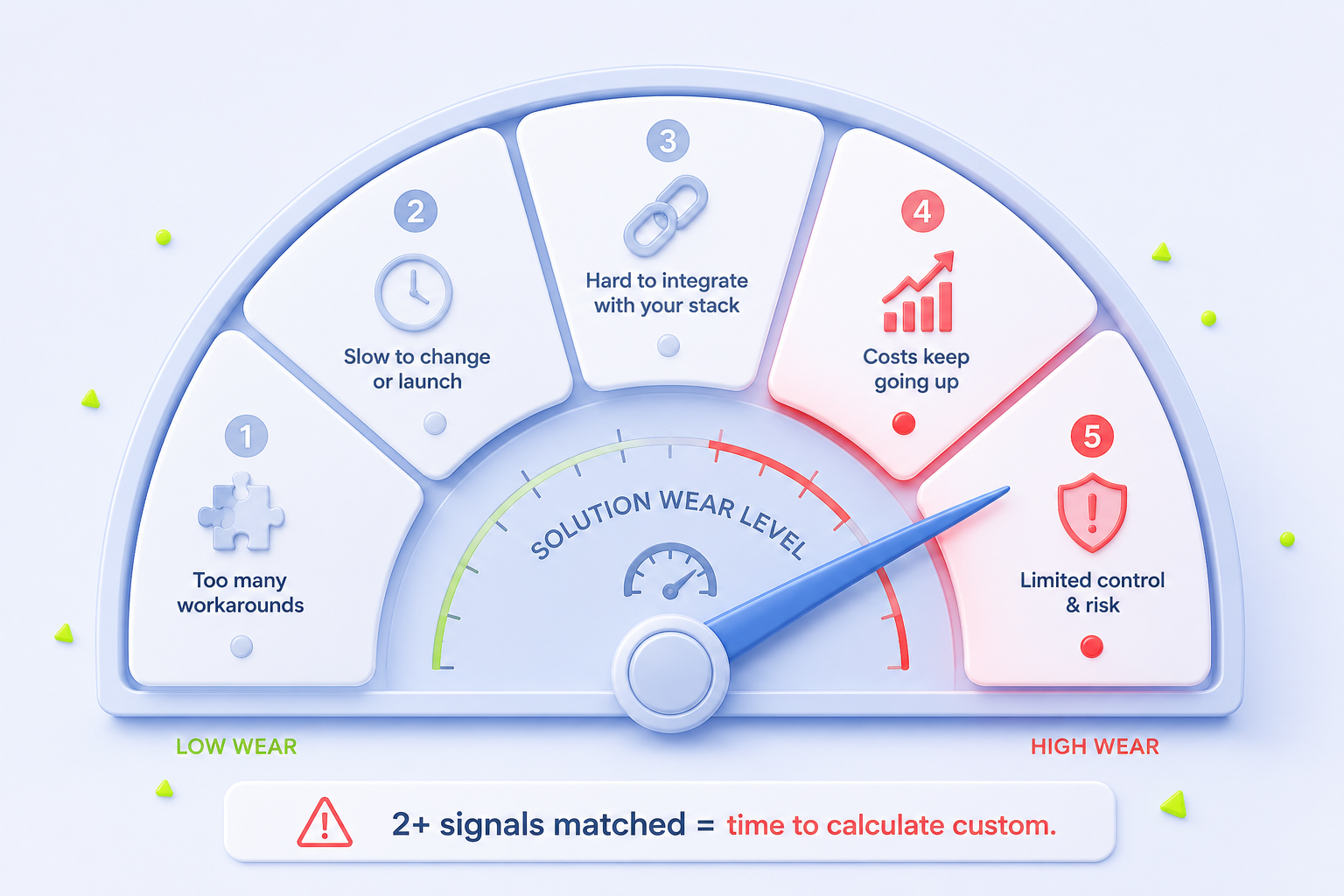
There are five signals that usually mean a ready-made solution has run its course for your business:
- Workarounds in your team have become more common than actual use of the platform's built-in features.
- You're paying for licenses, seats, and storage in volumes that exceed actual usage by 10x.
- The vendor's roadmap no longer aligns with your business priorities — and based on current trends, it won't going forward either.
- Company and customer data sitting in someone else's hands has turned into a legal or security risk.
- The time your team spends on integrations and workarounds has started to exceed the time spent on the core business.
Matching even two of these is already a clear signal. It's time to calculate the full cost of building your own alternative.
What Is the Real TCO of Custom Software?
The hidden cost of off-the-shelf
- The subscription grows along with your license count as your team scales.
- AI surcharge: 20–37% price increases at contract renewal are now standard practice in 2026, as vendors bundle AI features into base plans regardless of whether you use them.
- Shrinkflation: approximately 60% of vendors reduce features, eliminate lower-priced tiers, impose usage limits, or add surcharges while maintaining or increasing headline prices. A 7% renewal combined with feature reduction can mean an effective 15–25% cost increase.
- Customizations and API integrations are frequently billed separately, and aren't cheap.
- Hidden headcount — people spending their workdays on workarounds instead of productive work.
- Vendor lock-in risk: a price hike or a vendor shutting down leaves you without a same-day alternative.
The hidden cost of custom software
- Upfront phase: discovery, development, testing, deployment.
- Hosting and cloud costs — servers, storage, CDN, which used to be "included" in your SaaS subscription.
- DevOps — setting up CI/CD, monitoring, backups; for most custom products this is an ongoing line item, not a one-time task.
- Ongoing maintenance — updates, bug fixes, security patches: 20–25% of development cost per year is a more realistic benchmark than the often-cited 15%.
- Hosting, integrations, and post-launch refinement can separately add another 20–40% on top of the development budget — this isn't part of maintenance and is frequently left out of the initial estimate.
- Security audits — especially critical for regulated industries (HIPAA, PCI DSS), and this is a recurring cost, not a one-time expense.
- Feature development — the business continues to evolve, and the product has to evolve with it.
- Refactoring — in due time, technical debt has to be paid down, and that's a budget line item too, not an exception.
- The long-term cost of retaining a team or contractor.
- Opportunity cost — management time spent running the product.
How Much Does Custom Development Actually Cost?
The numbers vary widely by complexity, and this is exactly where most estimates go wrong:
- Simple internal tool / basic MVP: $20,000–$45,000
- Mid-complexity product (integrations, custom business logic, multiple user roles): $45,000–$100,000+
- Enterprise-level (compliance, complex architecture, high security requirements): $40,000–$400,000+
Note: AI-assisted development tools (Cursor, Copilot, Lovable, Bolt) are pushing down the lower bound for simple tools. Some MVPs in 2025–2026 are being shipped for under $10,000. But this applies to well-scoped, routine functionality — not complex business logic or compliance-heavy products.
Calculator: 5 Years in Numbers
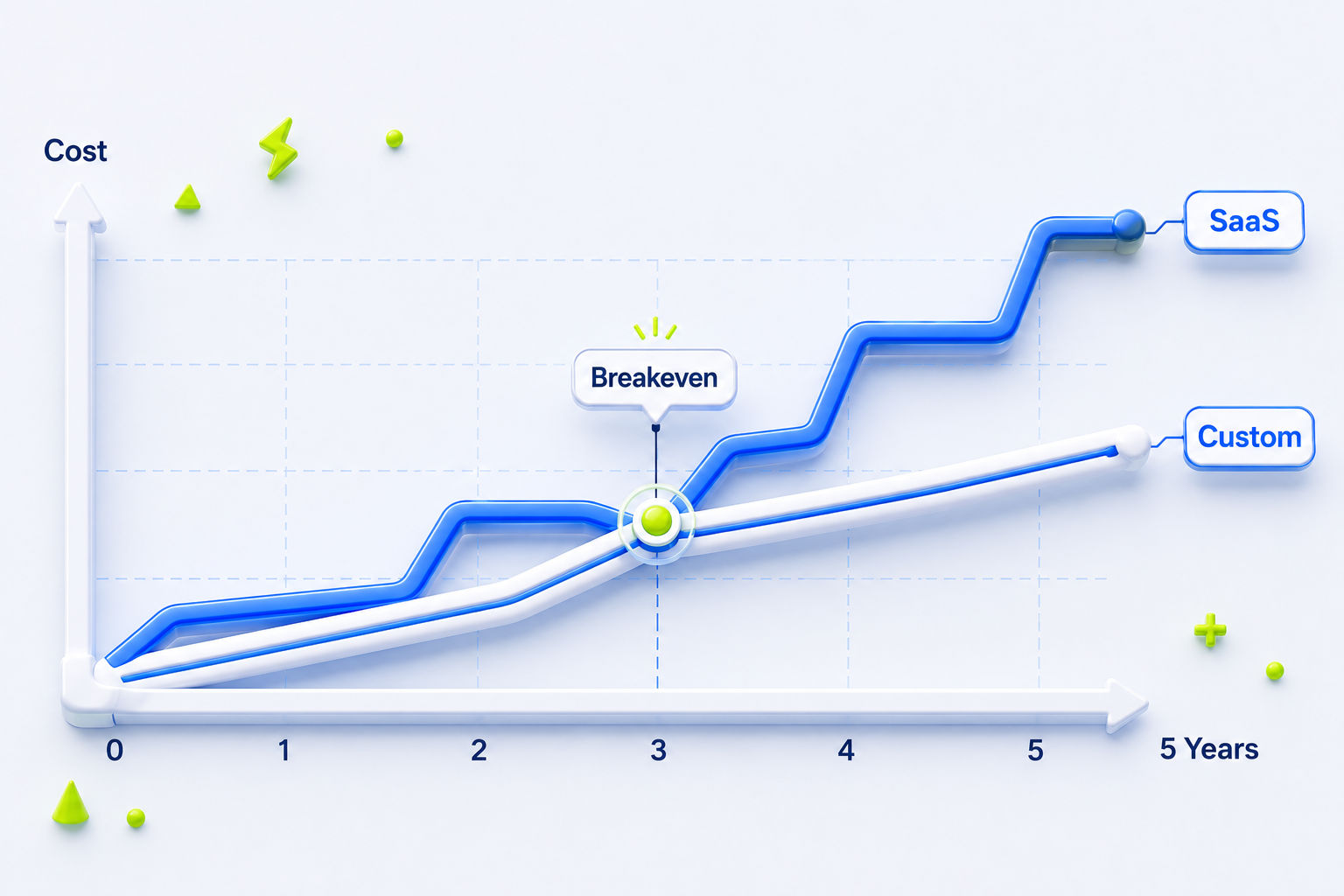
Scenario A — SaaS subscription. Starting at $800/month. After 3 years, the same functionality costs $2,400/month due to license growth and possible AI surcharges at renewal. Over 5 years, total costs come to roughly $100,000+.
Scenario B — Custom development of a simple internal tool. $35,000 upfront plus ~$8,000/year in maintenance (about 23% of development cost). Over 5 years — roughly $75,000.
In this example, custom becomes the cheaper option well before the 5-year mark, because the SaaS bill in Scenario A is fairly high and keeps growing with the team. But this cuts both ways. If your SaaS subscription costs $150/month instead of $800 and doesn't scale proportionally with your team, the breakeven point for the custom alternative pushes much further out — sometimes past the 5–7 year horizon. Sometimes custom doesn't pay off economically at all.
The breakeven point isn't a fixed number of years — it's a function of two variables: your current subscription cost and its rate of growth. A rough market benchmark: a $150,000 custom project breaks even in about 15 months — but only if the SaaS alternative costs around $10,000/month. At $800/month in SaaS spend and a $35,000 simple internal tool, the breakeven point arrives sooner — in the example above, around year 3 — which is exactly why you should run the numbers on your situation rather than borrowing this example.
Important: when calculating SaaS TCO in 2026, add a separate line for shrinkflation risk. A contract that looks stable may quietly erode in value at renewal — tighter support, removed features, or added usage caps — without any change to the headline price.
SaaS isn't always pricier than custom: for companies with stable processes and a fixed subscription, a ready-made platform can remain the better deal even over a 10-year horizon.
Real-World Scenarios: 4 Cases
Case 1: The e-commerce company where custom won
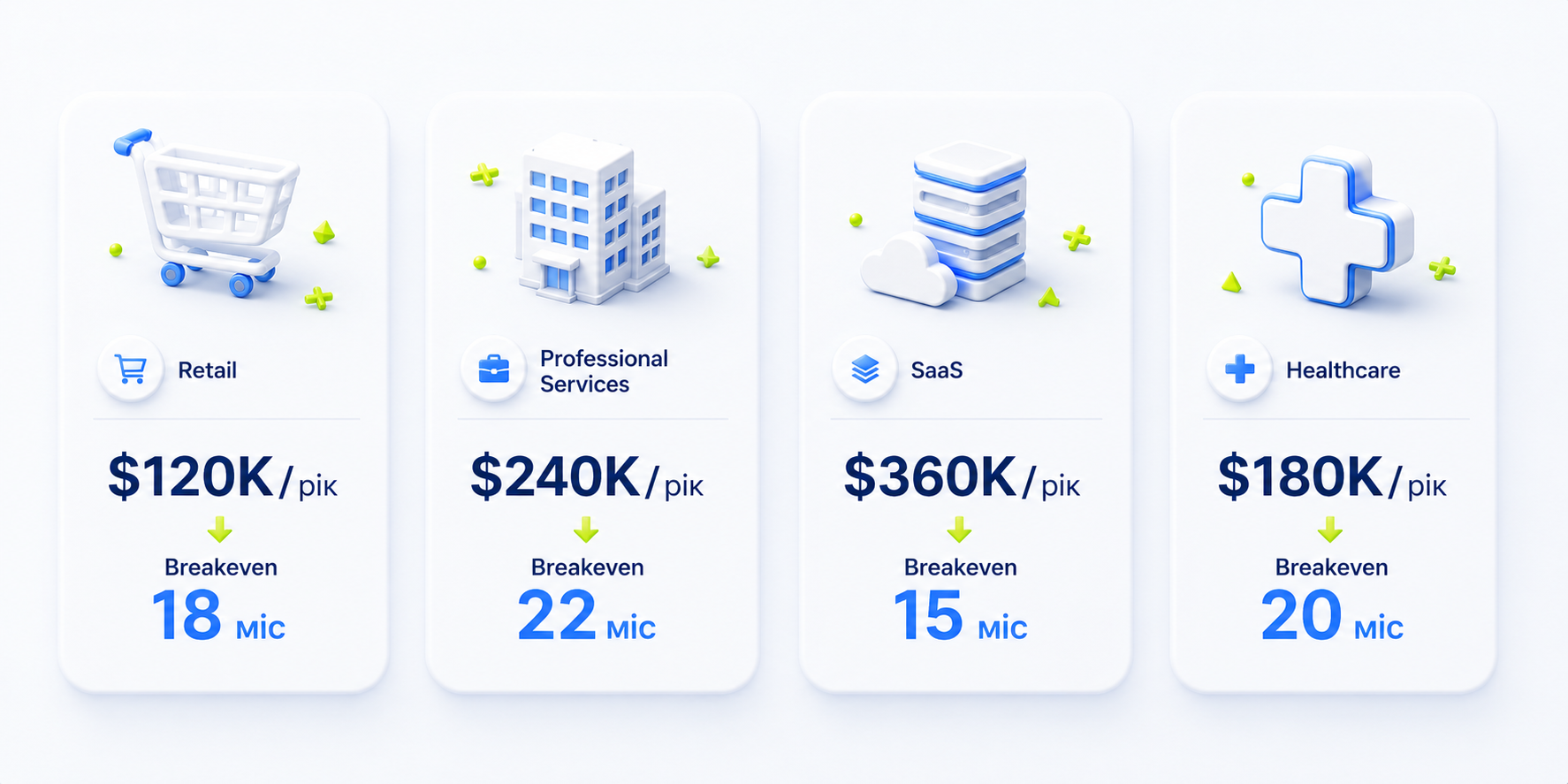
The business started on Shopify — the right call for the MVP stage. But at $5M ARR, Shopify fees plus paid apps had grown to ~$120,000 a year, and custom wholesale-client discounts and specific pricing logic simply weren't natively supported.
Moving to custom headless e-commerce cost ~$140,000 in development. With ~$80,000/year in savings on platform fees (the difference between Shopify spend and custom-solution maintenance), breakeven hit at 18 months.
Case 2: The early-stage startup where off-the-shelf was the right call
A young B2B SaaS startup (8 people, pre-seed) was considering a custom CRM because the sales team insisted their process was "unique." Instead, they went with HubSpot Starter at $50/month and had a pipeline set up within a week. 18 months later, the company had grown to 15 salespeople, but the sales process never became more complex than a standard B2B SaaS cycle — HubSpot still covers 90%+ of their needs.
Total cost over a year and a half: under $2,000. A custom build would have cost at least $30,000–$50,000 — money the startup invested in sales instead.
Case 3: The B2B SaaS company (internal tools) where custom won
The team had automated operations through Zapier, Notion, Airtable, and Slack — a typical no-code stack for getting started. Two years in: 12 integrations across those four services, data spread across five different systems, "spaghetti architecture," and $3,000/month in subscriptions and automations. A single custom internal tool (~$40,000 to build, falling within the "mid-complexity" range above) replaced all the services and all 12 integrations, consolidating the data into one place.
Savings on subscriptions came to $36,000/year — meaning the build paid for itself in a little over a year, not counting the time saved on manual data syncing.
Case 4: The medical clinic where custom won
The clinic was paying $80,000/year for an industry-specific off-the-shelf EHR system, of which only ~40% of the functionality was actually used, and the specific appointment-scheduling logic it needed was missing entirely.
A custom CRM with scheduling, HIPAA compliance, and the required workflow logic (budget closer to the enterprise range given the compliance requirements) paid for itself in 2 years — plus full control over patient data and a foundation for scaling across a clinic network.
Decision Checklist: 9 Questions Before You Choose
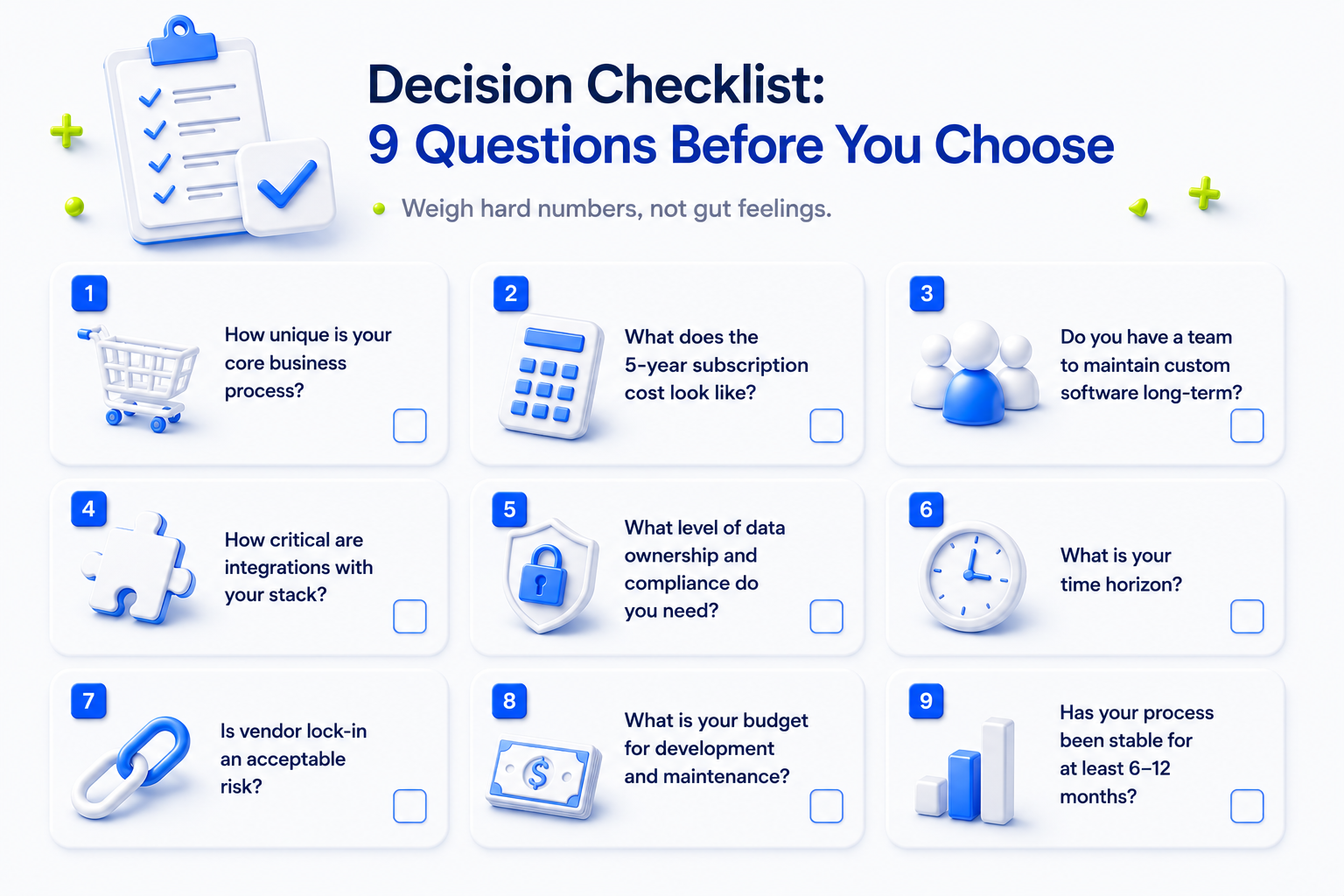
Go through this checklist — weigh hard numbers, not gut feelings:
- How unique is your core business process — is it a competitive advantage or a commodity function?
- What does the subscription cost × 5-year user growth actually look like? (projected monthly subscription cost in 5 years × 60 months, plus a buffer for possible AI surcharges and shrinkflation at renewal)
- Do you have (or can you hire) a team to maintain custom software long-term?
- How critical are integrations with your existing stack?
- What level of data ownership and compliance do you need?
- What is your time horizon — 12 months or 5+ years?
- Is vendor lock-in an acceptable risk at your current stage?
- What is your realistic budget for development AND ongoing maintenance? (upfront development estimate + 20–25% of that amount per year for maintenance, plus a separate 20–40% for hosting, integrations, and post-launch refinement)
- Has your business process been stable for at least 6–12 months, or is it still actively changing?
What to Do Next
Go back to the framework at the start of this article and identify your quadrant — process uniqueness and planning horizon.
If you landed in "competitive advantage + long horizon" and answered "yes" to 3 or more of questions 1, 4, 6, and 9 — commission a paid discovery phase (typically $3,000–$8,000 for a mid-complexity project) with a contractor or your internal team. A discovery phase gives you a fixed development estimate before you commit — and that's far cheaper than finding out the real cost after the fact.
Before signing off on the discovery, run a quick shrinkflation audit on your current SaaS spend: pull your last 2–3 renewal invoices and check whether the feature set or support tier quietly changed. If it did, that's a stronger signal to move than the subscription price alone.
If your case is closer to "commodity," or your planning horizon is short — start with off-the-shelf or a no-code MVP, and come back to this checklist in 12–18 months, once your process has stabilized and the scale becomes clearer.
