Cloud Managed Services: 5 Signs It's Time to Switch
Rising cloud costs, recurring incidents, security gaps, and overloaded engineers may signal it's time for Cloud Managed Services. Learn when switching makes business sense.

A company should transition to Cloud Managed Services when the complexity of its cloud infrastructure begins to outpace the capabilities of its internal IT team. This is typically reflected in uncontrolled cost growth, more frequent incidents, overloaded engineers, accumulating security risks, and difficulties with scaling. In such situations, it is advisable to reassess the cloud management operating model.
When Cloud Growth Becomes an Operational Challenge
Migrating to the cloud (AWS, Azure, Google Cloud) gives companies flexibility, scalability, and the ability to accelerate product development without investing in physical hardware. At the early stages, a small team can usually manage such infrastructure independently with ease.
However, as the business grows, the number of services, environments (production/staging), and integrations increases. Along with them, the requirements for security, availability, and cost control also grow. Isolated operational tasks gradually evolve into the continuous management of a complex platform.
The challenge arises when the scale of the cloud environment grows, but the operating model remains unchanged. Even a highly skilled technical team may struggle to standardize configurations, document changes, and analyze costs.
Who Needs Cloud Managed Services?
- Small businesses with simple infrastructure are generally better off managing their cloud environment independently, as this preserves control and saves resources.
- Growing companies should consider outsourced cloud management when the workload on their people and processes no longer matches the scale of the environment.
The 10-Minute Cloud Management Audit
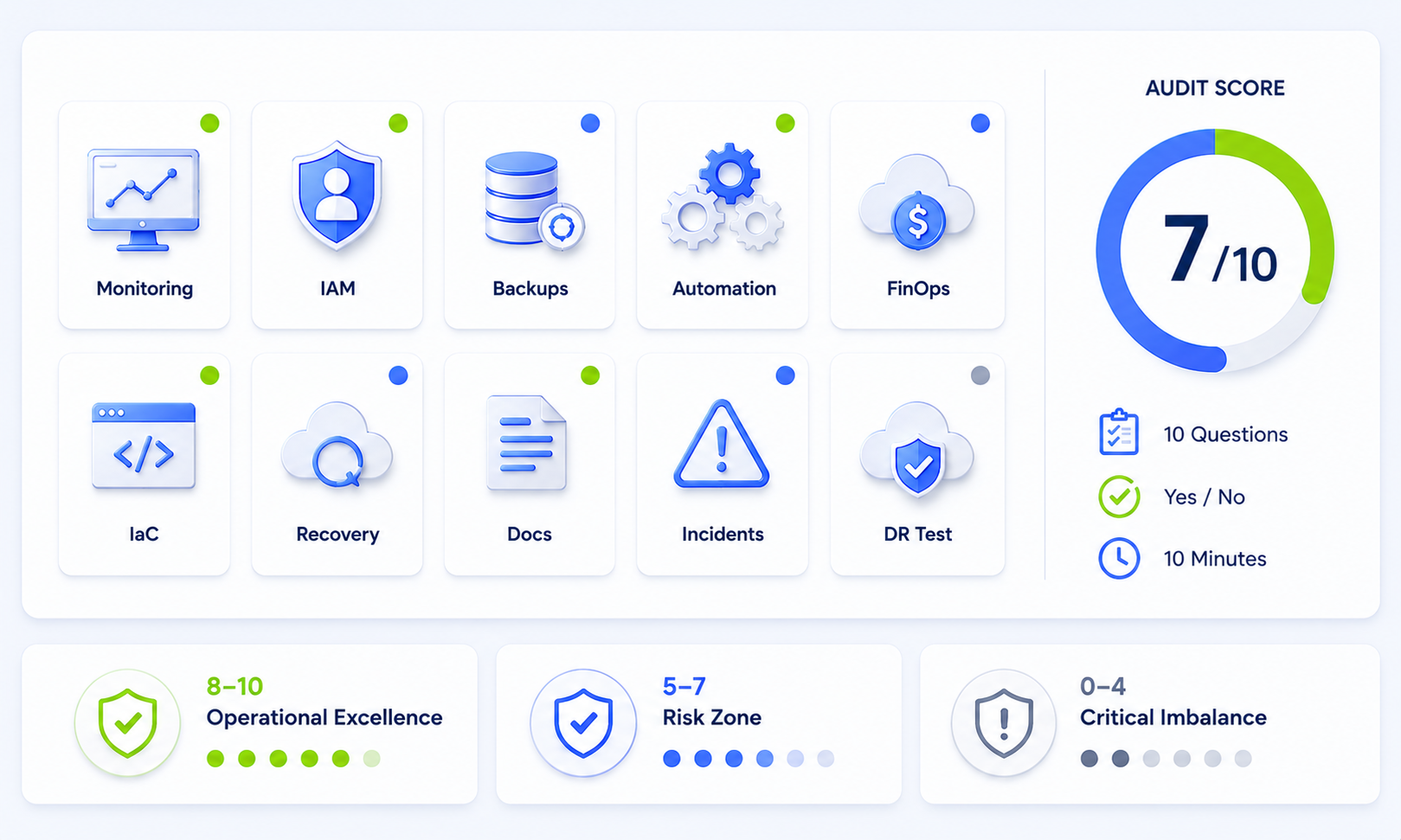
Answer each question honestly with "yes" or "no." This audit does not replace a detailed technical assessment, but it helps you quickly determine whether your infrastructure management processes remain under control.
- Can you explain why your total cloud bill changed this month and identify which products or teams generated the largest share of the costs?
- Does your IT team have centralized monitoring across all production systems, rather than separate dashboards for each service or application?
- Has your Disaster Recovery plan been tested within the last six months using a real failure scenario rather than existing only as documentation?
- Does your company have a clearly defined IAM policy with regular reviews of permissions, roles, and privileged access?
- Are routine operations — patch management, backups, scaling, and configuration updates — automated instead of being performed manually on an ongoing basis?
- Is there up-to-date documentation of the architecture, dependencies, and recovery procedures that is accessible to more than one person?
- Does your team have a formalized incident management process with runbooks, postmortems, and clearly assigned ownership for eliminating root causes?
- Does your company track how much time engineers spend on operational support, and does it remain within the level agreed upon by the team?
- Are backups tested for actual data recoverability rather than simply verifying that they were created successfully?
- Is your infrastructure managed centrally through Infrastructure as Code (IaC) and controlled deployment pipelines rather than through uncoordinated manual changes in the consoles of different platforms?
The results of this quick audit provide a clear assessment of the maturity of your cloud operations:
8–10 points (Operational Excellence): Your operating model is fully aligned with the scale of your infrastructure. Your processes are mature, and risks are well controlled.
5–7 points (Risk Zone): Your operational processes are beginning to fall behind the pace of development. Individual incidents can still be contained, but systemic gaps are already putting pressure on your SLA, time to market, and cloud budget. These areas should become a priority.
0–4 points (Critical Imbalance): Your current operating model no longer matches the complexity of your environment. Your team is overloaded with firefighting, while accumulated infrastructure debt is slowing down the business.
This audit evaluates not the qualifications of your engineering team, but how well your operating model matches the current scale of your cloud environment. Even the strongest senior engineers will become overwhelmed by routine work if the architecture has outgrown the management processes.
Five Signs You've Outgrown Self-Managing Your Cloud
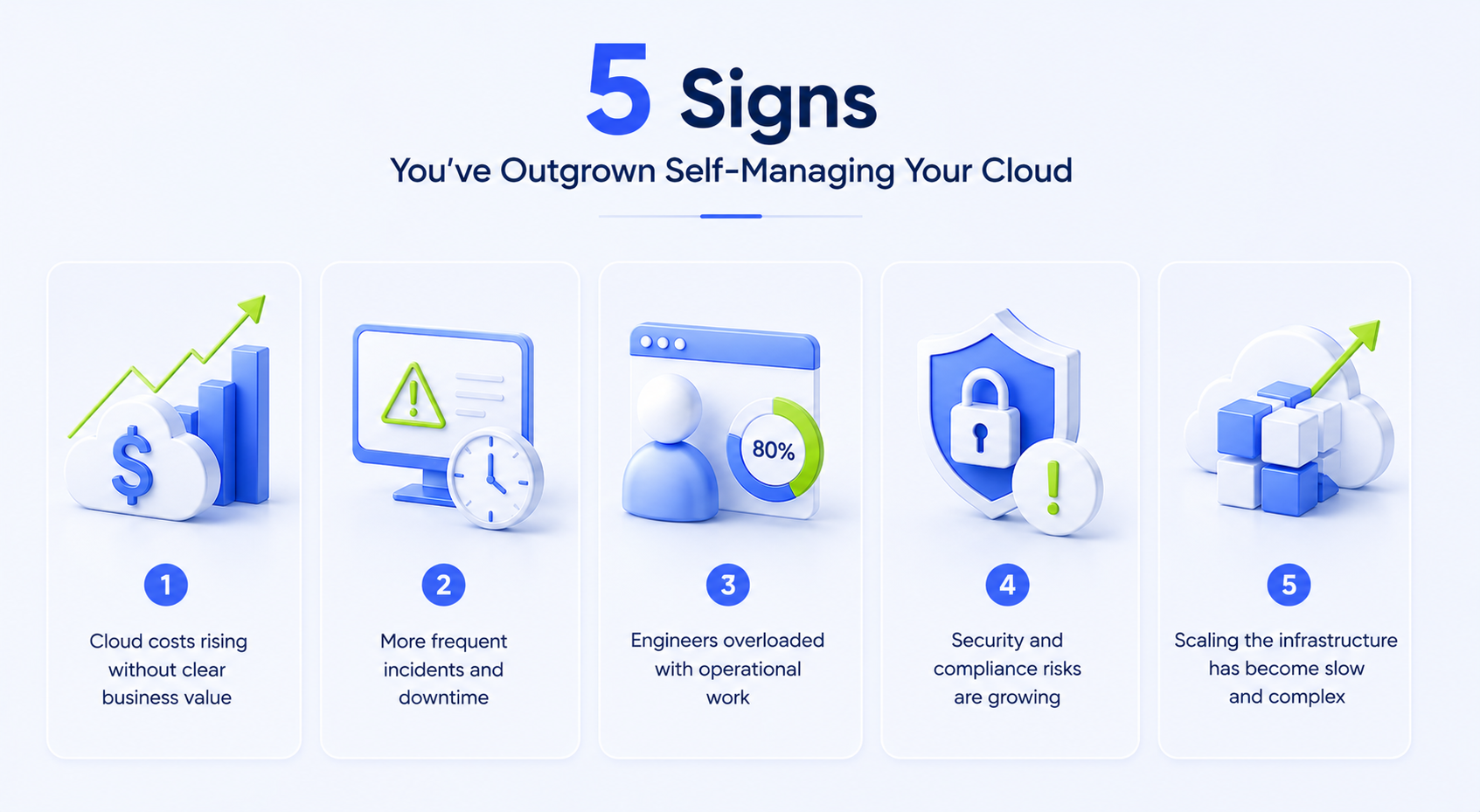
Below are five of the most common signs that managing your cloud environment in-house is creating more limitations than advantages.
Sign 1: Your Cloud Costs Keep Rising Without Clear Business Value
One of the first signs of a problem is when cloud bills grow faster than your workload or customer base. If these costs cannot be clearly linked to business outcomes, leadership loses visibility into what represents productive scaling and what reflects operational inefficiency.
Key Cost Drivers
- Overprovisioning and Idle Resources: Resources are provisioned with excessive capacity, while test environments, outdated snapshots, unused disks, and IP addresses continue generating costs for months after projects are completed.
- Kubernetes Blind Spots: Clusters often conceal inefficient resource allocation at the namespace and workload levels.
- AI/GPU Workloads: Costs rise rapidly due to long-running sessions, instances left running, or incorrectly selected infrastructure types.
- Multi-Cloud Complexity: In a multi-cloud environment, costs are spread across different platforms, accounts, and licensing models. Without a unified tagging system, the finance team sees only the total invoice rather than how costs are allocated to specific products.
The problem is not the size of the bill, but the absence of a transparent FinOps cycle — continuous cost analysis, forecasting, alerting, and clear team ownership of consumed resources. For the business, this results in unclear product margins and unpredictable financial planning.
According to the Flexera 2026 State of the Cloud Report, 29% of IaaS and PaaS spending remains inefficient. After five years of decline, this figure has started rising again.
Important: A one-time optimization delivers only temporary results — unused resources and excessive limits will inevitably accumulate again. In a mature cloud environment, cost control must be a continuous operational process rather than a reaction to a shocking invoice at the end of the month.
Sign 2: Your Engineers Spend More Time Running Infrastructure Than Building Products
The second sign is when your team spends more and more time maintaining the existing infrastructure instead of developing the product. Operational routine accumulates gradually: patch management, backup verification, monitoring tuning, IAM administration, troubleshooting, and Kubernetes updates create a constant stream of work that pushes product development into the background.
Why Teams Get Trapped in a Vicious Cycle
- Interruptions to planned initiatives: Urgent requests and incidents constantly interrupt the strategic work of DevOps and Platform Engineers.
- Automation stalls: Due to a lack of time, automation, environment standardization, and Developer Experience (DX) improvements are postponed. Engineers are forced to manually perform the very tasks that should have been automated.
- The scaling effect: As infrastructure grows, the number of routine operational tasks increases faster than the team can document or standardize them.
The Hidden Cost to the Business
Your most experienced specialists spend their valuable time not on architectural decisions or optimization, but on repetitive operational tasks and firefighting. Even if SLAs are formally met, the business still incurs losses in the form of:
- Delayed development deadlines and roadmap execution;
- Slower time to market;
- Reduced ability to respond quickly to market changes.
Important: Expanding the team provides only temporary relief but does not eliminate fragmented monitoring, insufficient documentation, or chaotic processes.
Sign 3: Every Incident Turns Into an Emergency
The third sign is when the company operates in a constant "firefighting" mode. In this model, every incident becomes an emergency involving late-night calls, manual trial-and-error troubleshooting, and critical dependence on the engineer who "knows where to look." Once the system is restored, the team immediately returns to day-to-day operations without having time for root cause analysis.
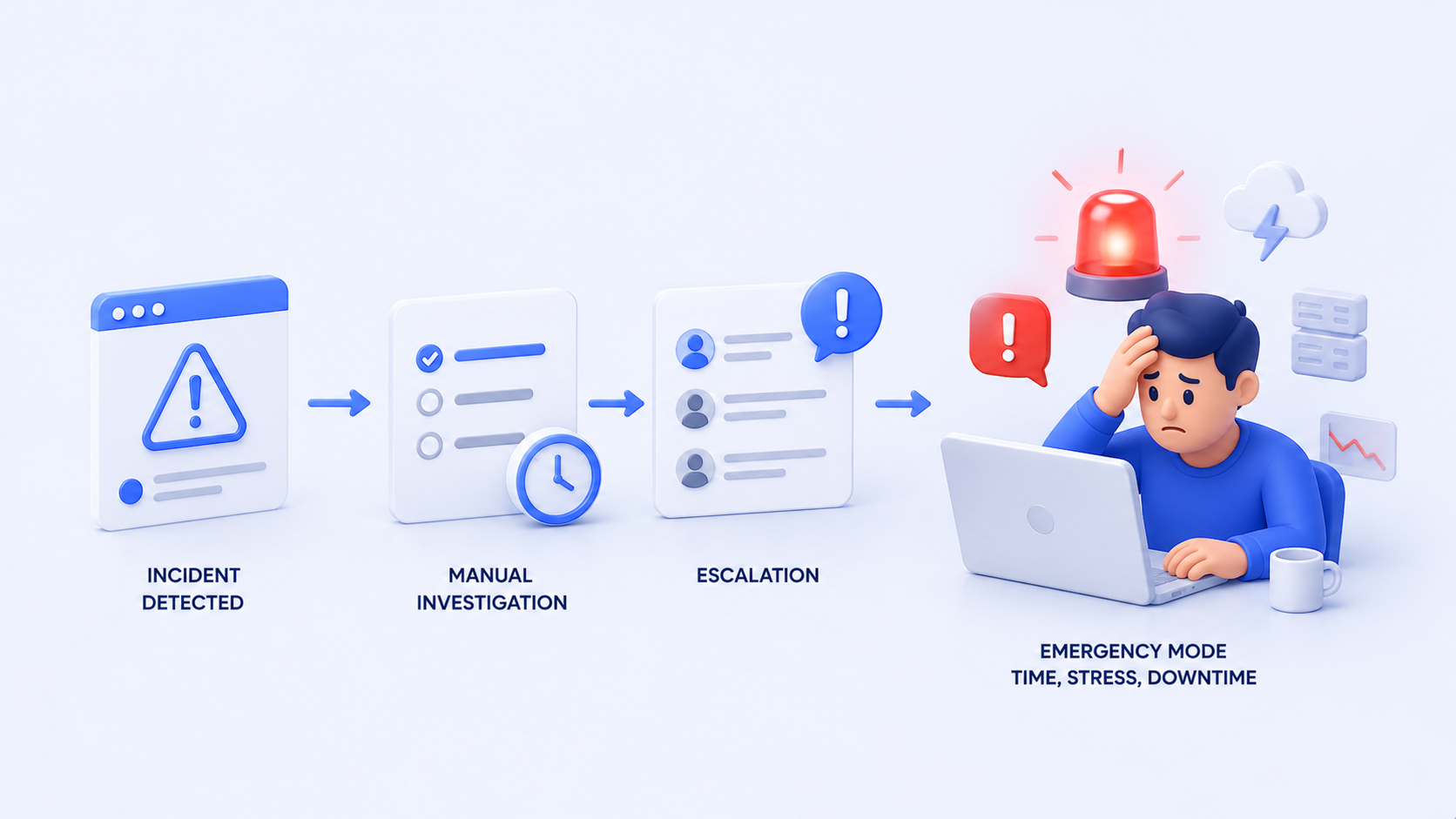
Indicators of a Reactive Approach
- Recurring incidents: The same networking, database, or application issue occurs for the third time in a single quarter. Each time, the team manually treats the symptoms instead of eliminating the underlying cause.
- Lack of runbooks and postmortems: Recovery procedures are either missing or outdated. Postmortems are not conducted or remain a formality that never leads to architectural improvements or automation.
- The reactive cycle: The more incidents occur, the less time remains for preventive work and improving observability. Technical debt continues to accumulate, while recovery times become increasingly unpredictable.
Business and Management Impact
A reactive operating model deprives the business of stability and creates direct financial and operational risks:
- SLA degradation: Availability metrics become little more than paperwork, releases are delayed due to unstable environments, and customers regularly experience service disruptions.
- High bus factor: Service recovery depends not on standardized processes but on the availability of individual key specialists.
- Team burnout: Constant overtime and overnight incidents lead to engineer burnout and increase the risk of losing critical knowledge if key team members leave.
Important: Infrastructure maturity is measured not by the complete absence of incidents, but by the ability to detect them proactively, restore services using proven procedures, and ensure that the same mistake never happens twice.
Sign 4: Your Cloud Environment Has Become Too Complex
The fourth sign is when infrastructure complexity exceeds the limits of human control. Complexity is defined not by the number of instances, but by the density of interdependencies: hybrid or multi-cloud architectures, Kubernetes, complex IAM models, isolated network segments, and dozens of microservices create a system that no single engineer can fully understand.
Sources of Hidden Infrastructure Risks
- The butterfly effect (Local changes — global failures): A minor change to a network policy or IAM role can remain unnoticed for months until it coincides with a service update and triggers a cascading failure in another part of the platform.
- IaC Configuration Drift: Any manual intervention ("hotfix") outside Infrastructure as Code (Terraform, OpenTofu, etc.) creates configuration drift between environments and makes future automated releases unpredictable.
- Lack of guardrails and governance: Without strict architectural standards and automated governance policies, the number of infrastructure exceptions and custom configurations grows exponentially.
The Impact of Complexity on Time to Market and Business
When an architecture becomes overloaded with interdependencies, the cloud loses its primary advantage — scalability at speed:
- Reduced developer velocity: Teams spend hours or even days waiting for staging environments to be deployed or access permissions to be granted.
- Slower onboarding: Bringing new engineering teams into the project becomes a lengthy and difficult process due to outdated documentation and a lack of system transparency.
- Expensive modernization: Any migration, core component upgrade, or security audit requires enormous effort to analyze indirect dependencies.
Important: Multi-cloud and hybrid strategies are often adopted to improve resilience or meet compliance requirements. However, without a mature centralized management model, they do not reduce risks — they simply add another critical layer of operational complexity.
Sign 5: Security and Compliance Always Stay One Step Behind
The fifth sign is when security and compliance tasks are constantly postponed. This is not the result of engineer negligence, but a classic conflict of priorities: unlike product features, patching, vulnerability management, and access reviews do not produce immediate business value. Under roadmap and deadline pressure, they are pushed into the backlog, creating critical security debt.
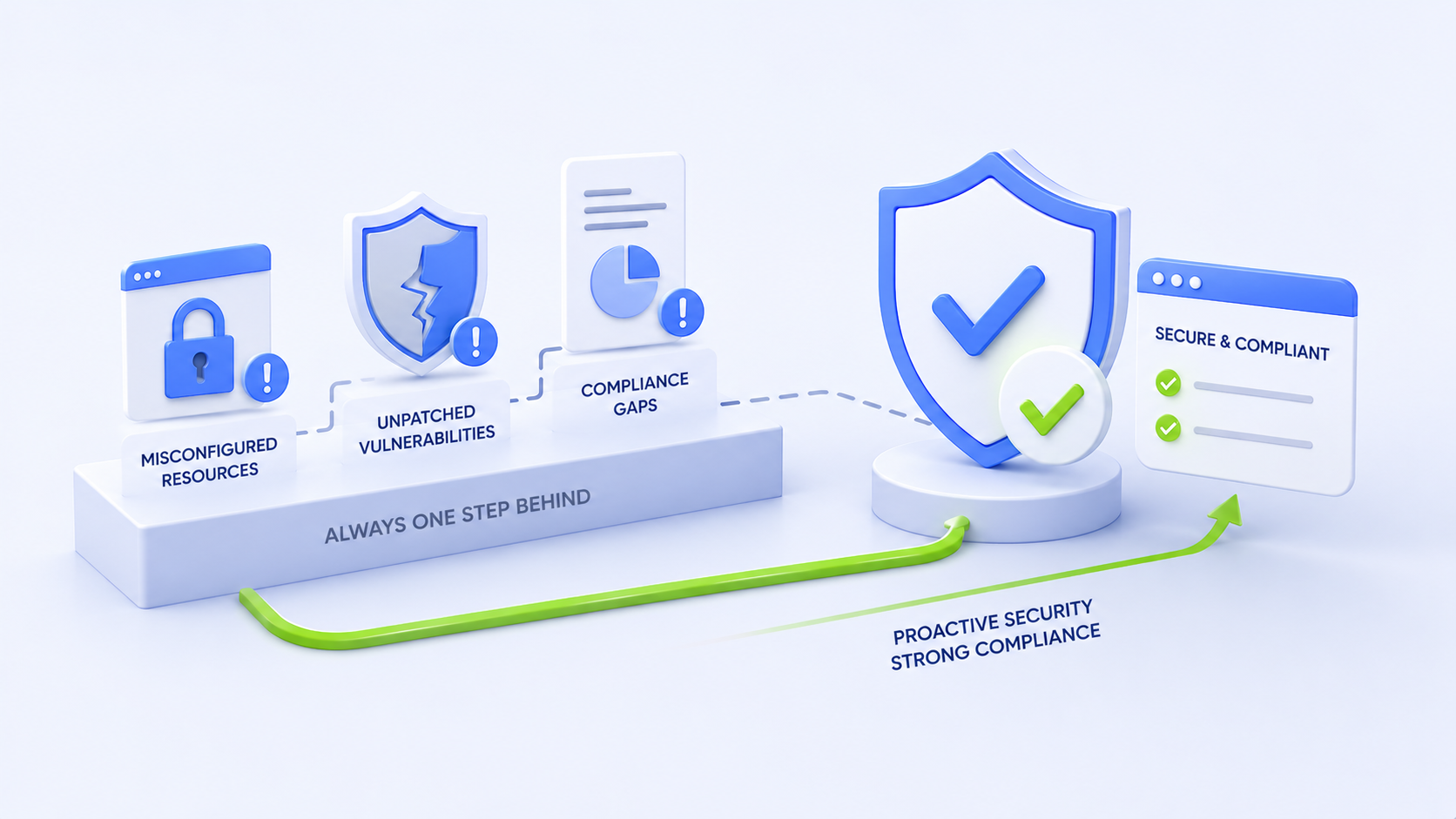
How Hidden Vulnerabilities Accumulate
- Degradation of security controls: Parts of the infrastructure continue running on outdated operating systems or packages due to frozen patch management, while security monitoring fails to cover newly added services and accounts, especially in multi-cloud environments.
- IAM policy erosion: Privileged accounts and excessive permissions remain active for former employees or after role changes because regular access reviews are not performed.
- The backup illusion: Backups are created automatically, but restoration procedures have not been tested for years.
Business Impact: From Regulatory Penalties to Reputational Damage
In regulated industries, weak cloud security quickly translates into business losses:
- Compliance and audit failures: The inability to demonstrate continuous monitoring and access controls prevents companies from signing contracts with large enterprise customers (Enterprise Readiness).
- Financial and legal pressure: In the event of an incident, companies face downtime, forensic investigation costs, reputational damage, and regulatory penalties.
- Exponentially increasing remediation costs: A core component update that once required only a few hours eventually turns into a risky and expensive migration due to years of accumulated dependencies on outdated libraries.
According to the IBM Cost of a Data Breach Report 2025, the average global cost of a data breach reached $4.44 million.
Important: Infrastructure security is not a one-time effort before an annual audit — it is a continuous operational cycle of validation and automated control.
When Self-Management Stops Scaling
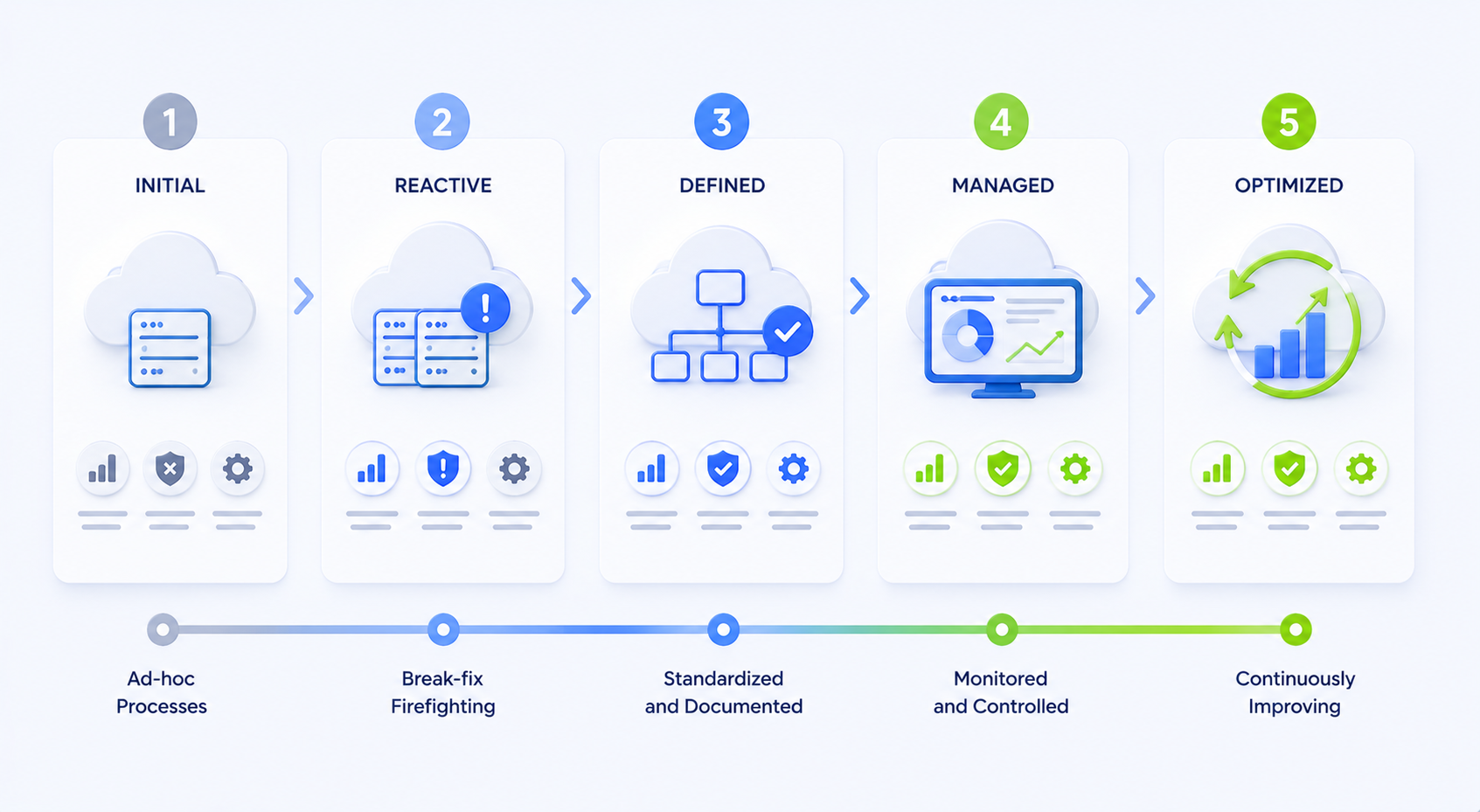
Companies go through different stages of cloud infrastructure maturity, and each stage may require a different operating model to remain effective. These stages are not a rigid classification — they help compare the complexity of the environment with the available processes and resources.
Startup
The infrastructure typically consists of one or two accounts on a single cloud platform, a limited number of services, and a simple deployment model.
The primary challenge is to validate the product hypothesis quickly without introducing unnecessary operational complexity. Self-managing the cloud with a small technical team is often sufficient, provided that basic access controls, backup practices, and cost management are established from the outset.
Growing
Production workloads emerge alongside more integrations, data, and environments. The team begins implementing Infrastructure as Code (IaC), centralized monitoring, and the first FinOps practices.
The primary challenge is maintaining development speed without sacrificing stability. At this stage, a dedicated DevOps or small Platform Engineering team may be sufficient, sometimes supported by external expertise for specific high-risk areas.
Scaling
The environment now includes Kubernetes in production, multiple business-critical systems, multi-cloud or hybrid components, and more demanding SLA and security requirements.
The primary challenge is standardizing operations at scale while preventing infrastructure support from replacing platform development. At this stage, a company may:
- Strengthen its internal SRE or Platform Engineering function;
- Adopt a co-managed operating model;
- Delegate repetitive operational tasks to an external team.
Mature
The infrastructure is distributed across multiple cloud platforms and regions, while business continuity, compliance, governance, and predictable cost management become top priorities.
The primary challenge is ensuring operational control and measurable performance at scale. At this stage, companies typically choose between a strong in-house SRE function, a fully managed operating model, or a hybrid approach. The decision depends on:
- Available expertise;
- Support costs;
- Control requirements;
- Willingness to invest in an internal operating model.
Adopting Cloud Managed Services (CMS) is not a sign of a weak engineering team, nor is it a mandatory step for every business. It is a rational response to the gap between increasingly complex infrastructure and limited internal resources.
What Changes After Switching to Cloud Managed Services
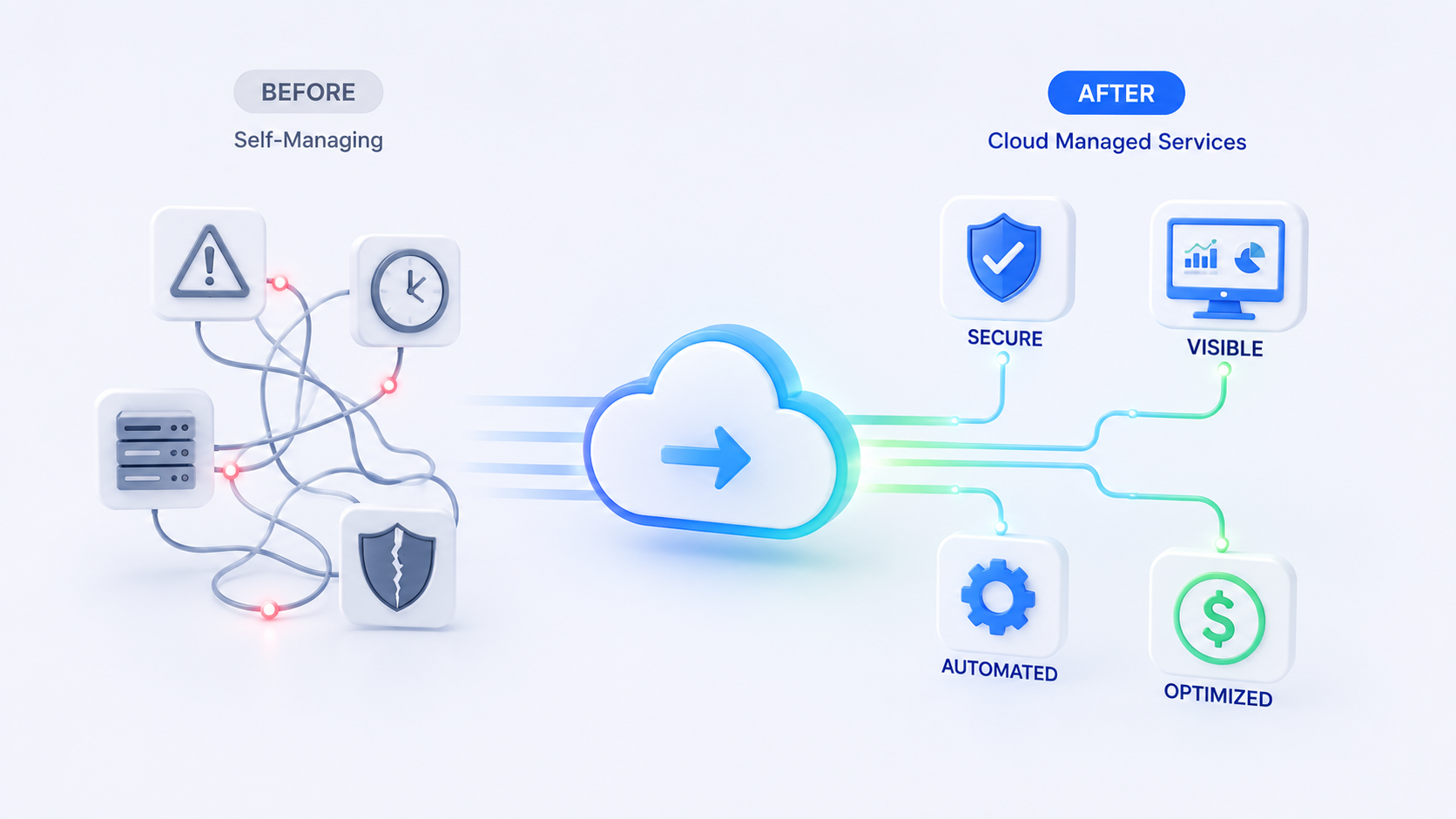
It is more useful to evaluate the difference between a self-managed and a managed operating model not by comparing the list of services, but by looking at how processes, responsibilities, and operational predictability change.
| Before Switching to Managed Services | After Switching to Managed Services |
|---|---|
| Reactive monitoring | Proactive anomaly detection and agreed incident response procedures |
| Manual repetitive operations | Standardized and automated processes |
| Unpredictable cloud costs | Regular cost analysis, forecasting, and optimization |
| Knowledge concentrated in individual engineers | Documented procedures and distributed ownership |
| Manual resource scaling | Scaling policies and automation |
| Fragmented visibility | Centralized monitoring and governance |
At the same time, the Cloud Managed Services model is not universal. It may not be suitable for companies with highly customized infrastructure or compliance requirements where critical operations must remain in-house. The primary risks include vendor lock-in, dependency on the provider, and the loss of internal expertise. These risks should be addressed in the contract through clearly defined responsibilities, ownership of documentation and Infrastructure as Code (IaC), knowledge transfer requirements, exit provisions, and governance mechanisms.
The most significant change is not simply who performs day-to-day operations. The company transitions to an operating model in which responsibilities, SLAs, recovery procedures, cost controls, and security requirements are formalized and measurable. At the same time, the internal team can retain ownership of the architecture, product priorities, and critical decisions, while operational responsibilities are defined by the contract and the roles and responsibilities matrix.
It is in this context that companies typically consider Cloud Managed Services: not as a universal replacement for the internal team, but as a way to align the operating model with the complexity of the environment. Before making the transition, it is important to determine which functions should remain in-house, which can be standardized or delegated, how service quality will be measured, and who will be responsible for decision-making during an incident.
A managed operating model does not eliminate the need for an internal technical owner. Without clearly defined objectives, architectural governance, and performance oversight, external support may simply shift fragmentation outside the organization. Before the transition, companies should establish baseline metrics for:
- Incident frequency;
- MTTR;
- SLA compliance;
- The share of manual operations;
- Budget variance;
- The amount of engineering time spent on operational support.
Otherwise, the company will not be able to objectively determine whether its operational efficiency has improved.
Conclusion
The cloud itself does not create the challenges described above. They arise when the number of services, environments, integrations, and security requirements begins to outpace the capabilities of the internal team and the maturity of the existing operating model. Rising costs, recurring incidents, operational overload, increasing complexity, and postponed security tasks are simply different manifestations of the same underlying gap.
If your company recognizes itself in several of these five signs, it does not mean your team is underperforming. In most cases, the infrastructure has simply reached a new stage of maturity while the operating model has remained unchanged. In this situation, it is worth evaluating several options:
- Strengthening the internal SRE or Platform Engineering function;
- Expanding automation or adopting a co-managed approach;
- Delegating part of the operational workload to an external team.
The key question is not whether cloud management should be outsourced, but whether the current operating model provides controlled costs, predictable SLAs, manageable risks, and sufficient time to continue developing the product. If the answer is increasingly "no," reassessing the operating model becomes not a marketing decision, but a practical step toward supporting the company's continued growth.
